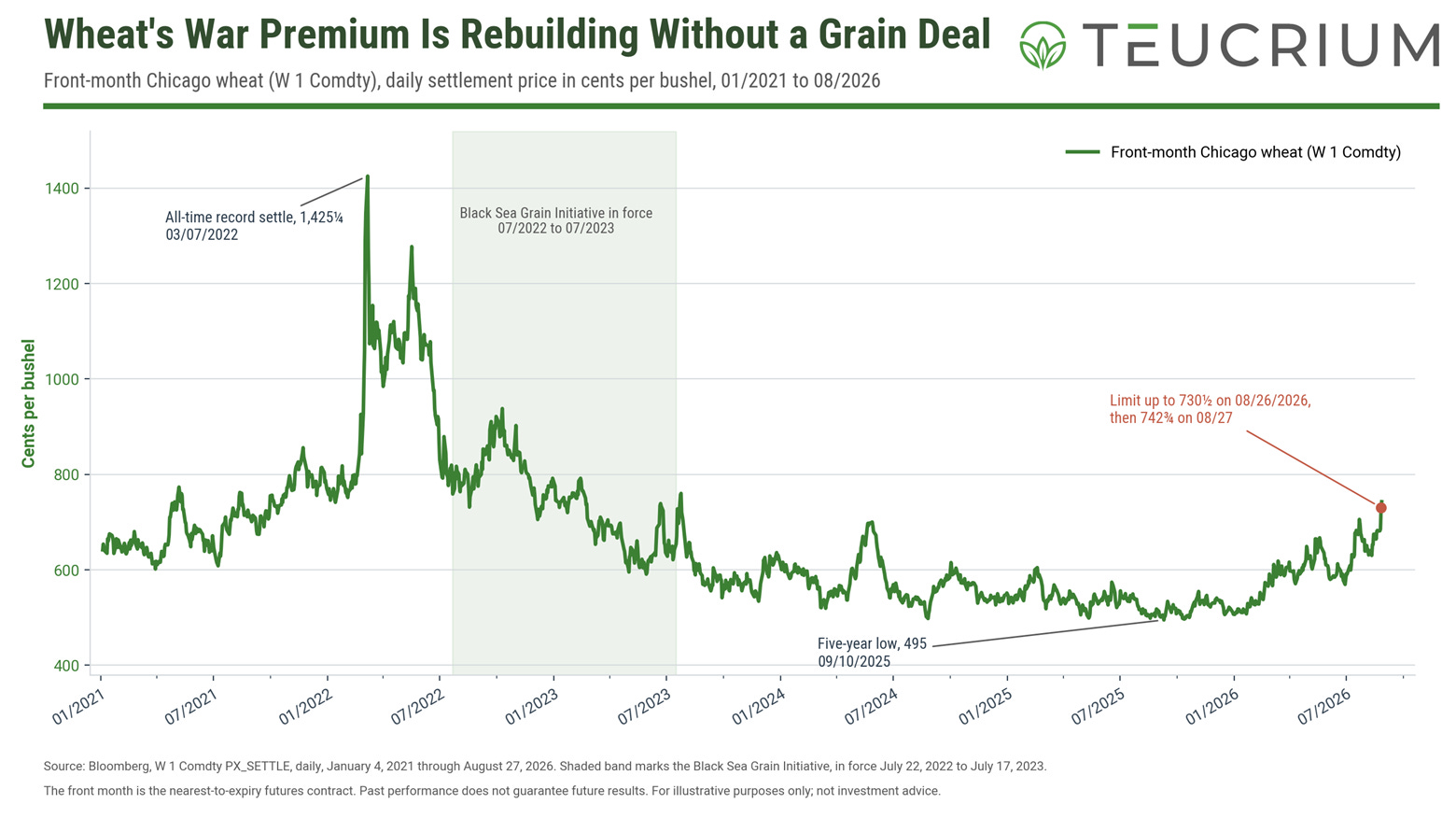
Chicago wheat locked limit up on Wednesday, making the largest move the exchange lets a contract make in one session.1 The front month, the nearest contract to expiry and the one most often quoted, is at a three-year high.2 The price strength is comes amid escalating violence in the Black Sea due to the Russian / Ukraine war. The market is working to price in the worst-case scenario it feared in 2022 that never materialized. That scenario is unfolding in real time today.3
During the initial invasion in 2022, wheat reached a record high of $14.25¼ as traders priced in a scenario in which no wheat would move through the Black Sea.4 But by July 2022 the UN and Turkey had brokered the Black Sea Grain Initiative, a maritime corridor deal wherein Russia pledged to not strike Ukrainian grain shipments.5 By early December front-month Chicago wheat futures retraced roughly 50% before closing out the year at $7.92 per bushel.6
Front-month Chicago wheat, daily settles, January 2021 through August 27, 2026. The shaded band marks the Black Sea Grain Initiative. Source: Bloomberg.
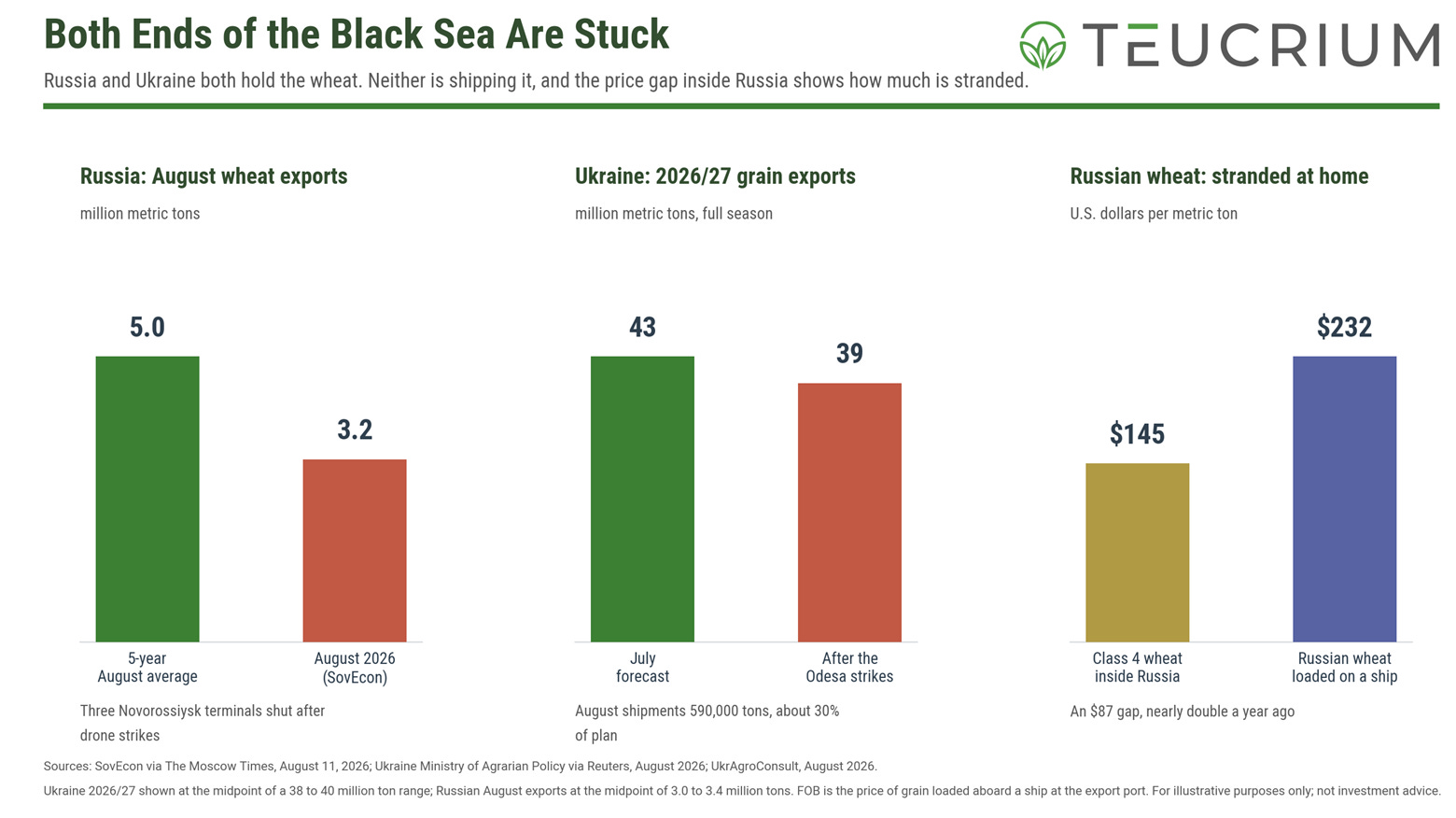
Both sides of the Black Sea are stuck
The facts on the ground today support the idea that the worst-case scenario may play out after all. There has been a significant escalation in violence as both sides are targeting ships and shipping infrastructure. Ukraine cut its 2026/27 grain export forecast by 12%, after Russian strikes on the Odesa port hub.7 Three deep-water ports that handle about 90% of Ukraine’s farm exports have stopped operating.8 August grain shipments came to 590,000 tons, which is roughly two-thirds behind the typical expected pace.9
Russia’s grain shipments are stuck as well. SovEcon, the Moscow agricultural consultancy, projects Russian wheat exports of 3.0 to 3.4 million tons in August against a five-year August average near 5 million.10 Three grain terminals at Novorossiysk, a complex that ships about 25 million tons a year, shut down after successful Ukrainian drone strikes.11
In 2022 the market had a relief valve. At the outset of the war when Ukraine faced a blockade Russia was still shipping wheat. Then came the Black Sea Grain Initiative and Ukrainian grain shipments started up again.
The escalation now cuts both ways, and while we hope that there are diplomatic efforts being made, there is no public report of negotiations pertaining to a new grain corridor. With the diplomatic offset missing, we believe the market is back to pricing in the 2022 worst case scenario. In 2022 it never became a reality, but that anticipated reality is unfolding now.
Ukraine’s 2026/27 figure is the midpoint of a 38-to-40-million-ton range: Russia’s August exports the midpoint of 3.0 to 3.4 million tons. Sources: SovEcon via The Moscow Times, Ukraine’s agrarian policy ministry via Reuters, UkrAgroConsult.
The bear case
Still, it is important to keep in mind that there is a difference between supply driven price rallies and availability shocks. The market is wrestling with the latter.
None of the grain has disappeared. The world has plenty of wheat. A large portion of that wheat is stuck in Russia, and local Russian wheat prices are tanking. Class 4 wheat, the mid-protein grade Russian farms sell into the export channel, has fallen to 11,000 to 12,000 rubles per ton, about $140 to $150. Russian wheat still quotes near $230 to $235 per ton FOB, short for free on board, the price of grain already loaded aboard a ship at the export port.12 The domestic-FOB price spread has nearly doubled over the past year, pointing to the fact that export demand has fallen off a cliff.13 Food wheat inside Russia is down about 18% since June, to 11,025 rubles per ton, and in some regions has fallen below the cost of production.14
A surprise corridor agreement, a lull in the port strikes, or a workable war-risk insurance fix, could unlock the supply. Analyst Allison Thompson, writing in Agweek, put it plainly: if terminals reopen and Russian wheat keeps reaching buyers through alternate routes, the market can remove the premium just as quickly as it added it.15
Managed money, the fund category in the CFTC’s weekly Commitments of Traders report, was net short 25,328 Chicago wheat contracts as of August 18, meaning funds held that many more short positions, bets on lower prices, than long ones.16 A meaningful share of this week’s move is funds buying back those sales. Once the short base is covered, the rally needs a fresh bid to keep going.
What it means for an allocator
Wheat has spent three years as the oversupplied, low-drama corner of the grain complex. The front month sits about 50% above its September 2025 low of $4.95 and still 49% below the March 2022 record.17 It has become an event-driven position with a genuinely two-sided distribution. In our view, current conditions argue for sizing the exposure appropriately given the volatility. The 2022 analogue is instructive at both ends. Prices went to a record on fear, then gave most of it back with a diplomatic solution.
What we’re watching
Three things: vessel traffic entering Odesa, whether the Novorossiysk terminals restart, and the Russian domestic-to-FOB spread. On the last one, watch for domestic prices to rise relative to the FOB price. This would suggest that exporters are back in the domestic market, bidding up prices to ship grain out.
In the near-term the price chart, in our view, appears inviting to speculators looking to trade momentum and we expect to see net longs reported on the COT Report soon. At the same time, if a deal is struck, the shorts may pile on quickly, jumping on the opportunity to sell wheat at what today amounts to 3-year highs.
Still, significant infrastructure damage on both sides suggests that shipping volumes may be slow to recover, even after the shooting stops.
And if the shooting doesn’t stop soon…then we are likely watching the worst-case scenario unfold.
Notes: