Soybeans
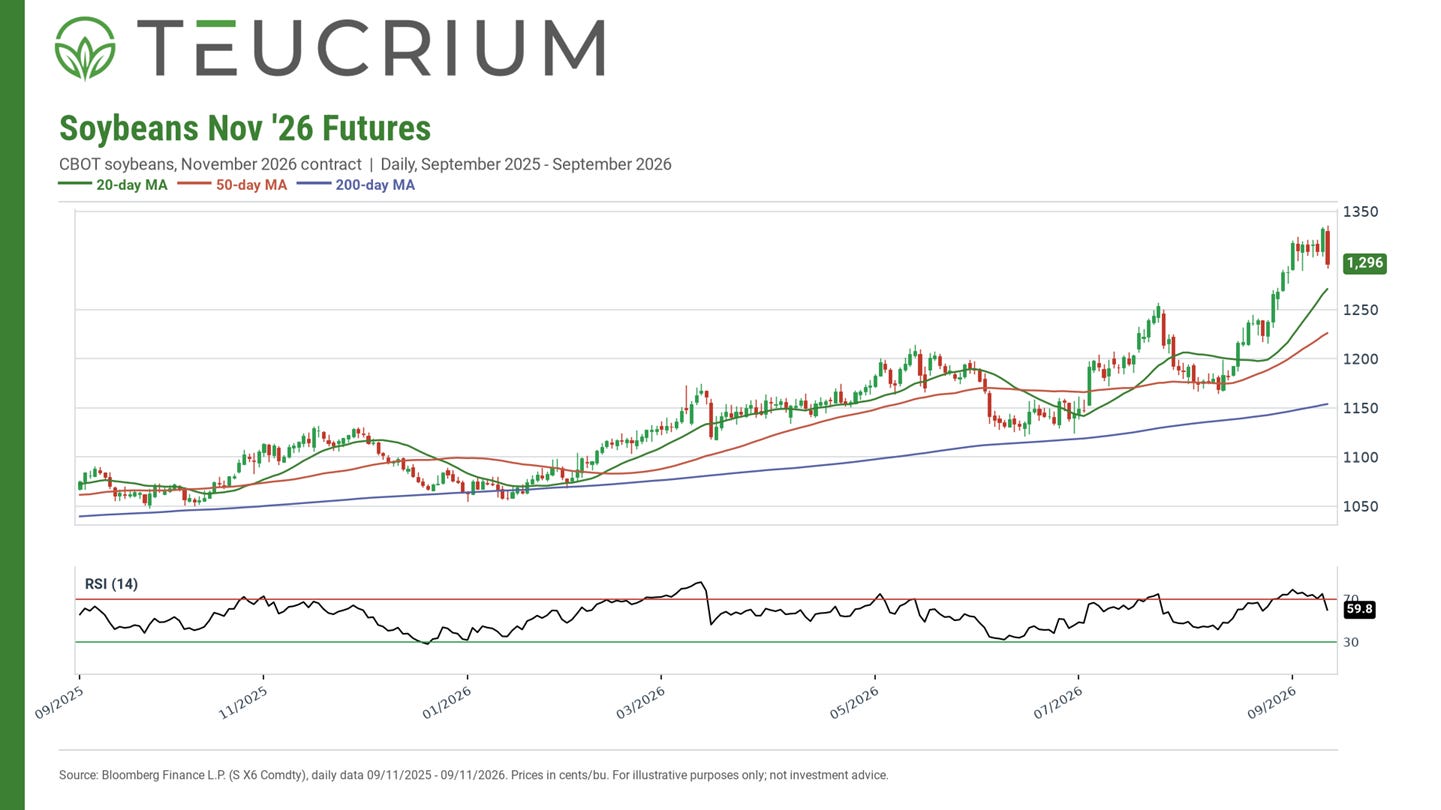
November soybeans settled at $12.96 1/2 Friday, down 35 3/4 cents, and lost 13 1/4 cents on the week. The contract printed a new high of $13.35 1/4 early Friday, then closed near the day’s low after USDA’s report, a key reversal on the daily chart.
China was buying bushels. Reuters’ sources counted roughly 1 million metric tons of US soybeans bought this week ahead of Xi Jinping’s visit to Washington, and USDA confirmed flash sales to China on Wednesday (340,000 tons) and Thursday (272,000 tons), with another 306,500 tons to unknown destinations across the two days.
Weekly export sales for the week ending September 3 came in at 96.9 million bushels, above the top of the range.
The profit taking began in the wake of the USDA WASDE Report. Yield projections increased a tenth to 52.8 bushels and production was up 16 million to 4.535 billion, against a trade that expected 52.4 and 4.492 billion.
Exports were raised 25 million bushels to 1.685 billion on the China pace, so 2026/27 ending stocks still fell 10 million to 310 million, but that was 12 million above the average guess. Marex’s Tim Bulfer called it “neutral to slightly negative” and wrote that the market “had been expecting friendly numbers but didn’t get them.”
Managed money was net long 257,258 contracts as of Tuesday, September 8 (CFTC, futures only), up 22,338 on the week and the largest in the disaggregated series back to 2006, so the reaction to a miss was naturally lopsided. The demand story is real. The supply story just got 16 million bushels less tight.
The Trump-Xi meeting is the next catalyst. Standard Grain’s Joe Vaclavik notes Chinese private crushers are running negative margins with a 10% tariff still on US beans and are hoping the visit brings a cut.
A tariff concession could support prices even as harvest starts, and Beijing still needs December and January coverage. A stall could leave the record long looking for an exit. StoneX’s customer survey has yield at 53.0 bushels, which would make the crop a record 4.547 billion bushels if realized, and 26% of the crop is already dropping leaves against a 20% average, so field yield reports may arrive early. Friday’s weekly low close may invite follow-through selling early next week; a hold above the 20-day average near $12.71 would argue the report was a one-day event.
Corn
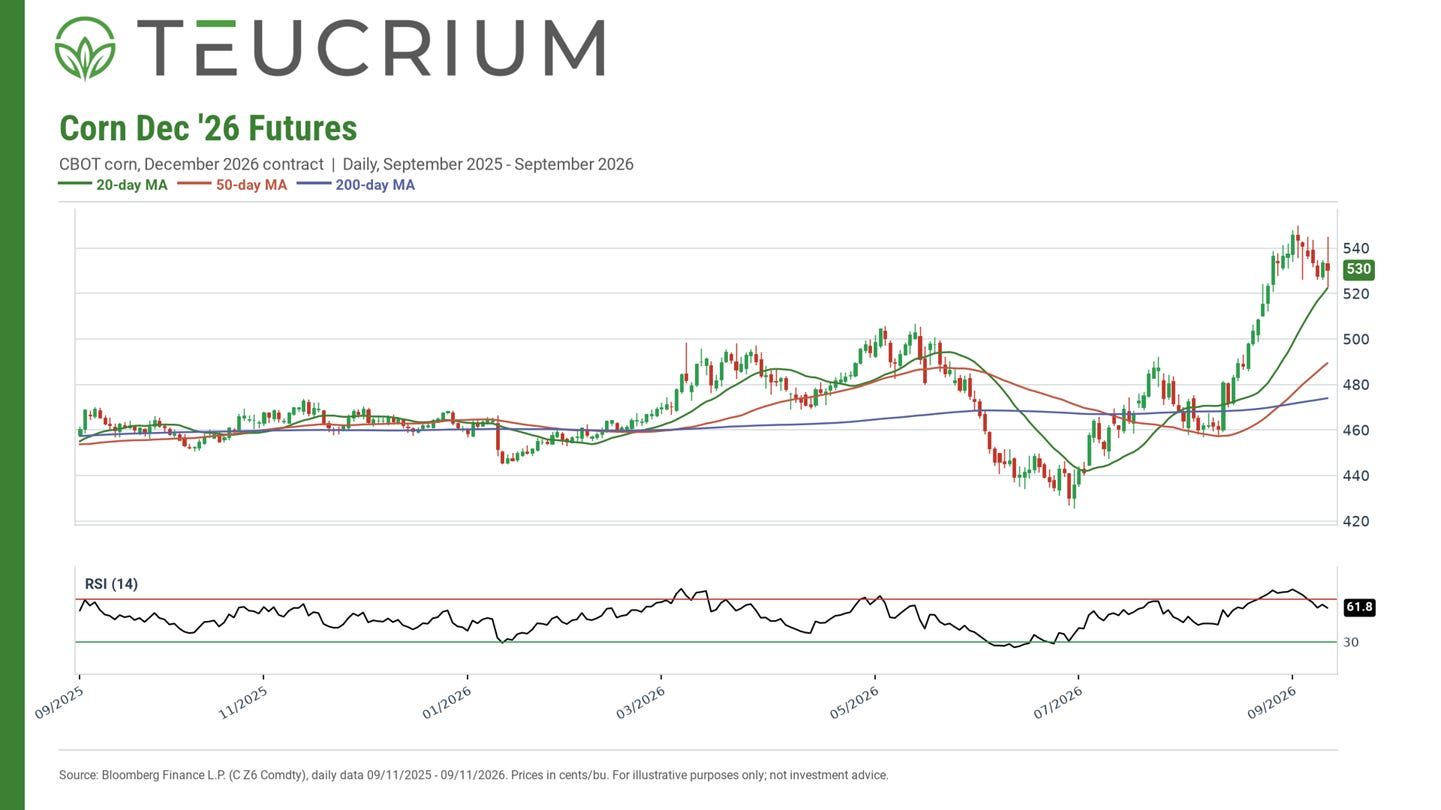
December corn settled at $5.30 1/4 Friday, down 3 1/2 cents, and finished the week down 6 1/2 cents. It traded a 21 1/2 cent range on report day, from $5.44 3/4 to $5.23 1/4, and briefly turned positive after the numbers before fading.
USDA cut its corn yield 2.2 bushels to 178.5 and production 213 million bushels to 15.800 billion, in line with analyst expectations.
The ending stocks projection fell 86 million to 1.567 billion bushels, taking the stocks/use ratio below the psychologically important level of 10%.
Old crop demand finished strong: 2025/26 exports were raised 25 million to 3.425 billion, weekly sales of 75.9 million bushels beat the top estimate, and Mexico took a 264,000 metric ton flash sale Friday morning.
Managed money added 13,456 contracts to reach a 414,459-contract net long as of September 8. That is the largest managed money net long in the CFTC’s disaggregated futures-only record, which starts in June 2006, passing the 409,444 from March 2011.
Vaclavik wrote Tuesday that the futures-only position had not yet set a record; this week’s data closed that gap. The report was friendly on paper, but record longs need more than friendly…as the saying goes, “you need to feed the bull.”
Harvest is 5% done and cash basis is slipping as new crop receipts arrive. Pro Farmer’s wrote that that harvest pressure “has left funds cautious to extend their positioning much further.”
Still, Demand could keep a floor under prices. The European Commission expects EU corn imports near 25 million metric tons this season against 19.3 million last year after drought cut its own crop by roughly 10 million tons, and Vaclavik notes US corn was more than two-fifths of EU imports in July and August with Ukraine largely offline.
Watch the lower Mississippi, which World Weather expects to reach its low-water threshold near Cairo, Illinois this weekend, and diesel at a record $6.05 a gallon; both widen basis and could keep farmer selling slow.
Marex’s report note says the numbers are priced in and fund dominance leaves the market “set up for some good breaks.” A close back under the 20-day average near $5.22 would be the first sign of one.
Wheat
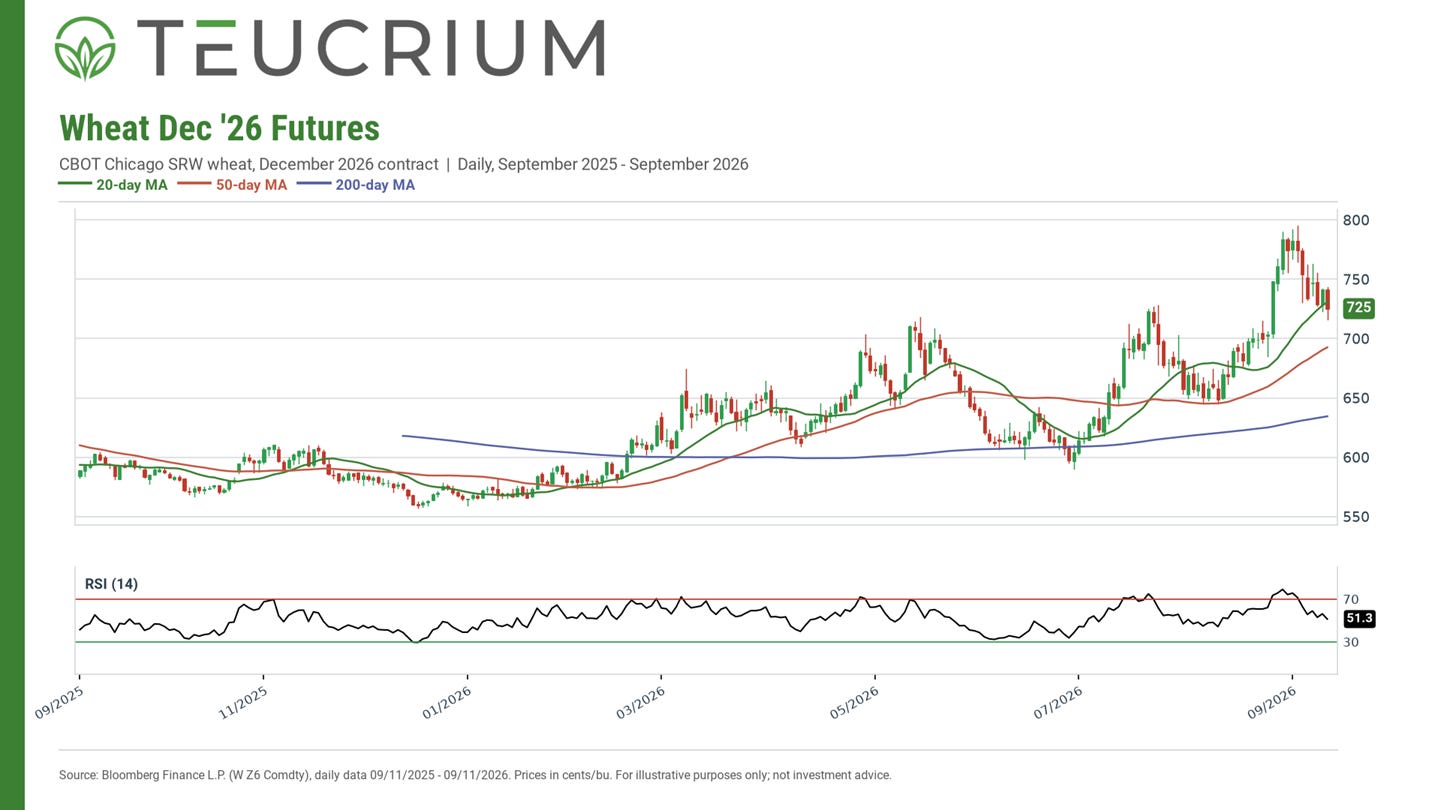
December Chicago wheat settled at $7.25 1/4 Friday, down 16 cents, and lost 8 3/4 cents on the week. December Kansas City finished at $7.98 1/2, down 20 1/4 on the day and 3 3/4 on the week. December spring wheat closed at $7.45, down 17 1/2 Friday and unchanged on the week. Chicago closed under its 20-day average for the first time since the August rally got going.
The trade remained focused on Black Sea headlines. Steve Witkoff and Jared Kushner left Moscow with no breakthrough, and Bloomberg’s sources said Putin intends to take all of Donetsk within six months. That was good for a 13 cent rally Tuesday. Then on Wednesday, Kremlin spokesman Dmitry Peskov said he hopes talks “resume in the foreseeable future” and Chicago gave back 18 ¼ cents.
Still, the violence continues.
Ukraine hit Novorossiysk, Russia’s biggest Black Sea port, Wednesday; Russia struck Mykolaiv, a Moldovan border crossing used for overland grain, and a Bunge sunflower oil refinery in Dnipro.
Ukraine’s agriculture ministry says the country has shipped 630,000 metric tons of farm goods so far in September, running some 60% below normal. SovEcon cut Russia’s 2026/27 wheat exports 7.2% to 41.4 million tons and, as Standard Grain’s Joe Vaclavik relayed, argues this could be a bigger shock than the first half of 2022 because both exporters are blocked this time, where 2022 only closed Ukraine.
USDA agreed on the margin, cutting Russian and Ukrainian exports a combined 4 million tons, but it also raised world 2026/27 ending stocks 3 million to 276.29 million tons on bigger Australian and Canadian crops and left the US carryout at 717 million bushels. Marex’s Bulfer: “There are plenty of supplies but the big focus remains on the Black Sea logistical problems.”
Positioning agrees. Managed money cut its Chicago net long to 4,873 contracts as of September 8 from 14,904 a week earlier, while Kansas City held near 48,700. US export sales fell to a marketing-year low of 7.1 million bushels, and StoneX’s Mike Castle notes weekly inspections were the weakest for the week since at least 2013.
Winter wheat planting is 2% done against a 5% average with 59% of the area in drought, and the fall crop insurance price discovery period runs through Monday at levels Castle calls “very lofty relative to recent years,” which could buy acres.
Canada’s Prairies had their wettest start to September in 50 years and the slowest harvest since 2019, a quality story if the rain continues.
Bulfer wrote Tuesday that “the upside risk seems to be mostly in the wheat.” With the funds nearly flat and the physical market still broken, another week like this one could turn on a single headline out of Moscow, in either direction.
Sugar
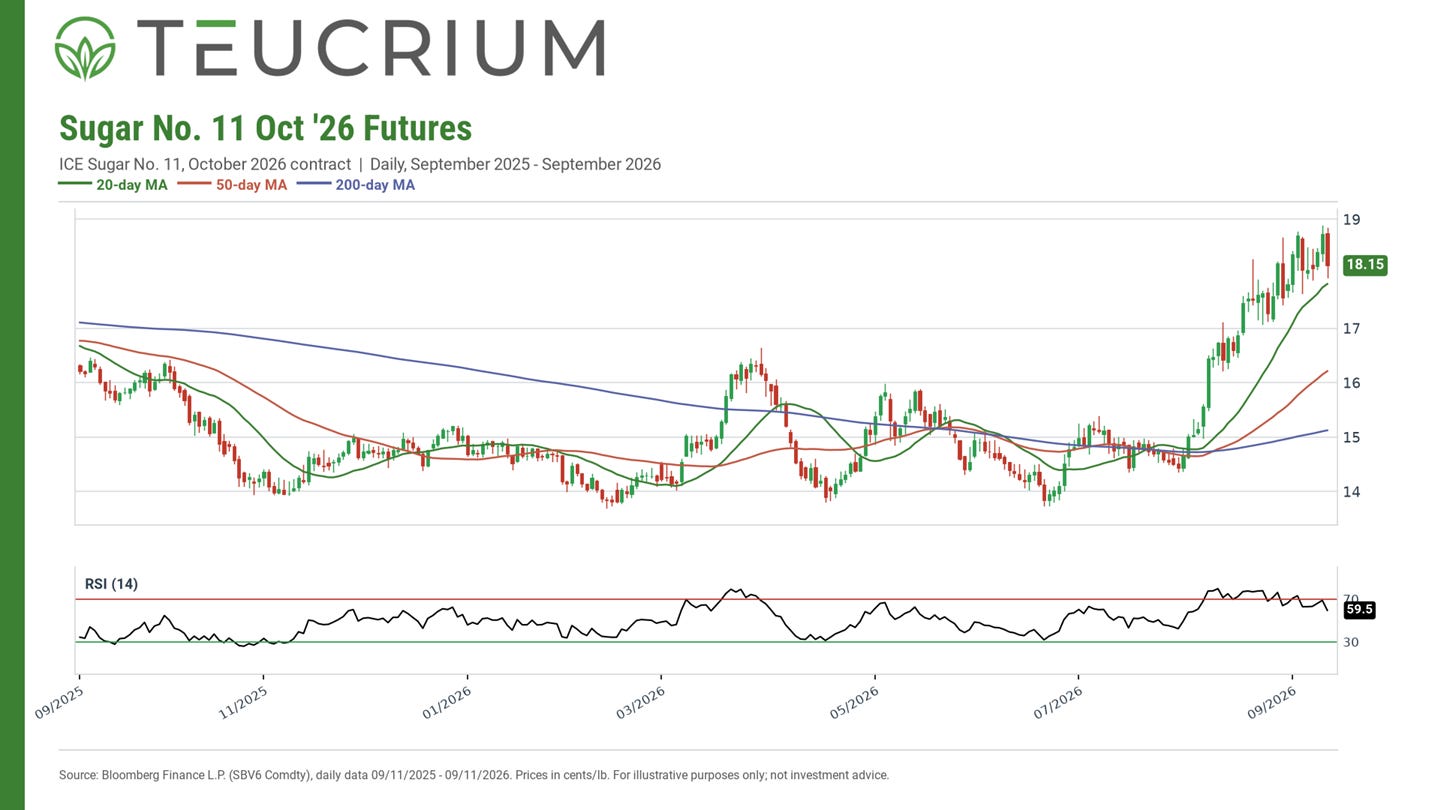
October Sugar No. 11 settled at 18.15 cents Friday, down 58 points, or 3.1%, but finished the week up 8 points.
Friday’s trade was an energy trade. WTI fell close to 5% and Brent more than 3% after Thursday’s 6% surge, as StoneX’s Mike Castle noted, and Brazilian mills price the choice between sugar and ethanol off that number.
Cepea’s read from São Paulo is that the extra cane crushed in the Center-South lately has gone to ethanol, keeping crystal sugar supply restricted “for the remainder of the cycle,” with hydrous ethanol up 3.8% and anhydrous up 6.8% in the week to September 4.
Brazil’s August sugar exports were 2.7 million metric tons, down 27.5% year over year, and January through August shipments are down about 11% at 17.94 million tons.
There are issues in Asia as well. Thai Sugar Millers Corp’s Rangsit Hiangrat said Thailand’s 2026-27 output may fall at least 17% to under 10 million tons from 12 million as El Niño dries the northeast, and the International Sugar Organization now carries a deficit near 260,000 tons for the coming season.
India, normally an exporter, has applications for 800,000 tons of its 1 million ton duty-free import quota and is buying from Brazil for the first time in nearly a decade; ISMA puts 2025-26 output near 27.9 million tons against consumption of 28.5 to 29 million.
Managed money’s net long grew 4,913 contracts to 238,684 as of Tuesday, the largest since January 2023 and about 30,000 shy of the 2021 peak.
The demand-side pushback is starting to show. Indian ex-mill prices have dropped to 43,000-44,000 rupees a ton from 65,000-67,000 two weeks ago as imports land, and New Delhi may restrict cane juice and B-heavy molasses for ethanol, as it did in 2023, which would add sugar to the domestic balance.
Watch crude first: oil above $100 keeps Brazilian mills leaning toward ethanol and may support prices, while a sustained break lower in crude could pull the mix back toward sugar and take some of the premium out.
However, a Super El Niño hit to Thailand’s and India’s cane production has the potential to continue pushing prices higher.
See how money managers are positioned. Check out our CFTC Managed Money Monitor here: https://teucrium.com/cftc_managed_money_monitor