Soybeans
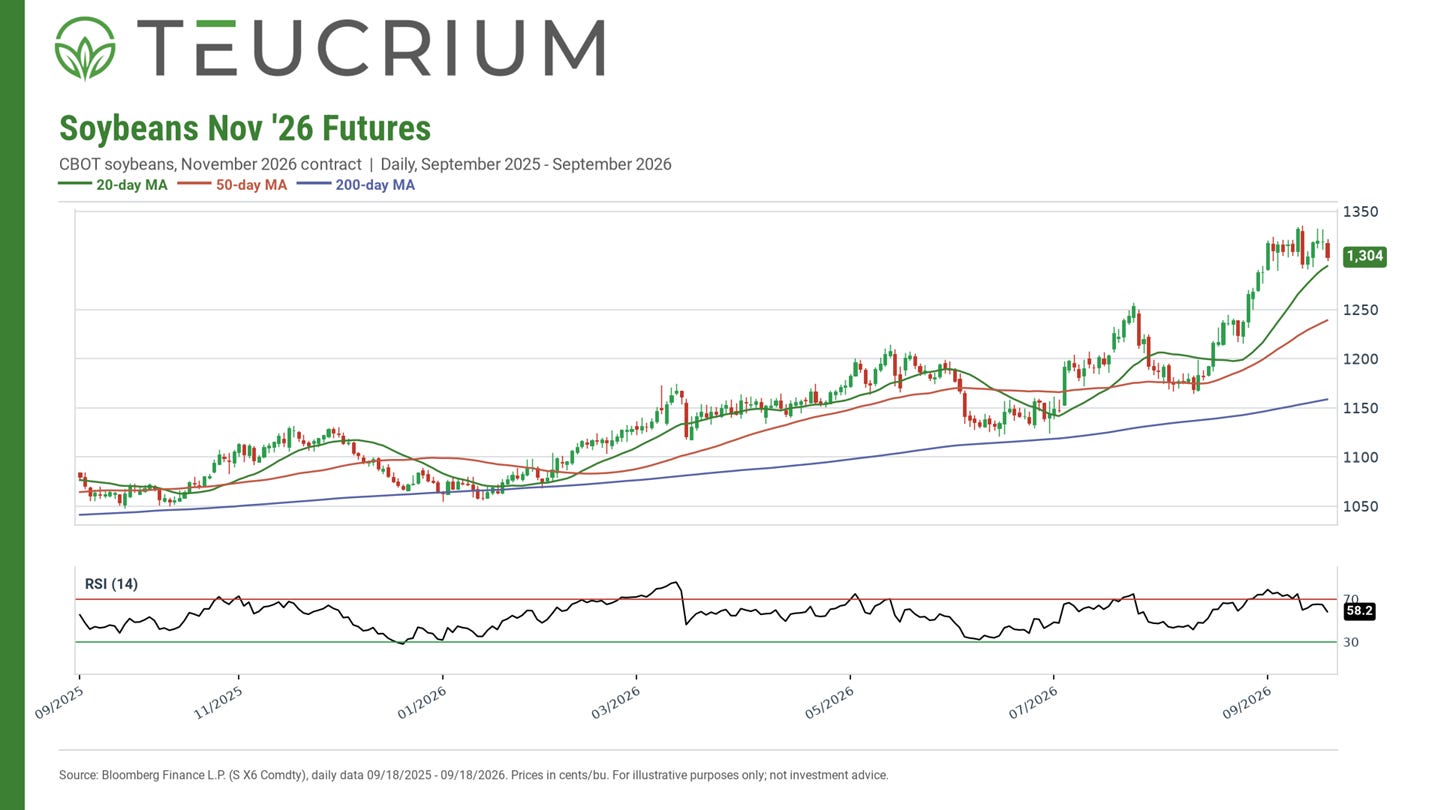
November soybeans settled at $13.03 1/2 Friday, down 16 1/4 cents, and still finished the week up 7 cents. The week’s big move was in soybean meal. December meal ran to $371.30 Thursday, a 2.5-year high for the contract, then gave back $12.70 Friday to settle at $358.60, up $5.80 on the week. December bean oil fell 93 points Friday to 68.22 cents and 146 points on the week.
The meal rally started with the NOPA crush report. Members crushed 205.456 million bushels in August, an 11-month low, down 5.2% from July and short of the 211.6 million the trade expected; soybean oil stocks fell to 1.201 billion pounds, the lowest since November 2024.
Standard Grain’s Joe Vaclavik put it plainly: rain across the western Corn Belt is delaying harvest just as crush plants are struggling to secure beans, meal sales are running at a record pace, and US meal is competitive with South America, so tight bean supplies are producing a meal shortage.
Pro Farmer added that domestic end users have become short-bought, and Marex’s Tim Bulfer heard talk of western crush plants running low on beans.
StoneX’s Mike Castle took the longer view: NOPA’s cumulative crush is 2.580 billion bushels, up 12% on the year and a record, but if USDA’s own August number tracks NOPA the marketing-year total lands 8 to 9 million bushels under USDA’s target, so a small downward revision may be coming.
Friday’s selling came from traders exiting spreads. The traders who had bought meal against bean oil and beans against corn and wheat earlier in the week took the trades off, Bulfer wrote, and “big swings in the meal/oil spreads over the last few days is simply amazing.”
China kept buying all week: traders counted more than 1 million metric tons booked last week, taking the marketing year to roughly 13 million tons by traders’ count (about 9.1 million officially confirmed) against the 25 million ton annual commitment, USDA flashed another 111,000 tons Friday morning, and China was the top buyer in the 1.7 million ton weekly export sales print.
Managed money trimmed its net long to 241,501 contracts as of Tuesday, down 15,757 from the prior week’s record 257,258, before Friday’s break. Bloomberg reported overnight that Washington will hold any new tariff announcements until after next week’s summit, and Vaclavik wondered aloud whether that delay, which keeps the tariff threat on the table for the negotiation, was why beans traded lower Friday morning. “I’m not sure,” he wrote.
The Xi visit is Thursday, September 24. Treasury Secretary Bessent meets his counterpart He Lifeng this weekend, the two sides are discussing tariff cuts on US energy and farm goods inside a roughly $30 billion framework, and Cofco representatives may travel with Xi, so the market is positioned for an announcement of fresh purchases.
Charlie, who writes Marex’s morning note, described the risk on both sides: it’s hard to press the short side ahead of the summit, and “the Chinese have not telegraphed their buying intentions in the last 5,000 years of their civilization.” Sinograin also goes back to auctioning 543,000 tons of reserve beans Tuesday.
On the crop, Pro Farmer’s Michael Cordonnier held 51.5 bushels an acre while the Pro Farmer economists see pod weights recovering toward a record 53.3, against USDA’s 52.8.
Watch for whether meal’s Friday reversal turns into a broader liquidation of the long bean, short cereal spreads that dominated the week, and whether the summit produces a number or a communique. Nov beans may need news of a Chinese purchase to hold $13.00, and a disappointing summit could pressure prices back toward the 50-day moving average near $12.39.
Wheat
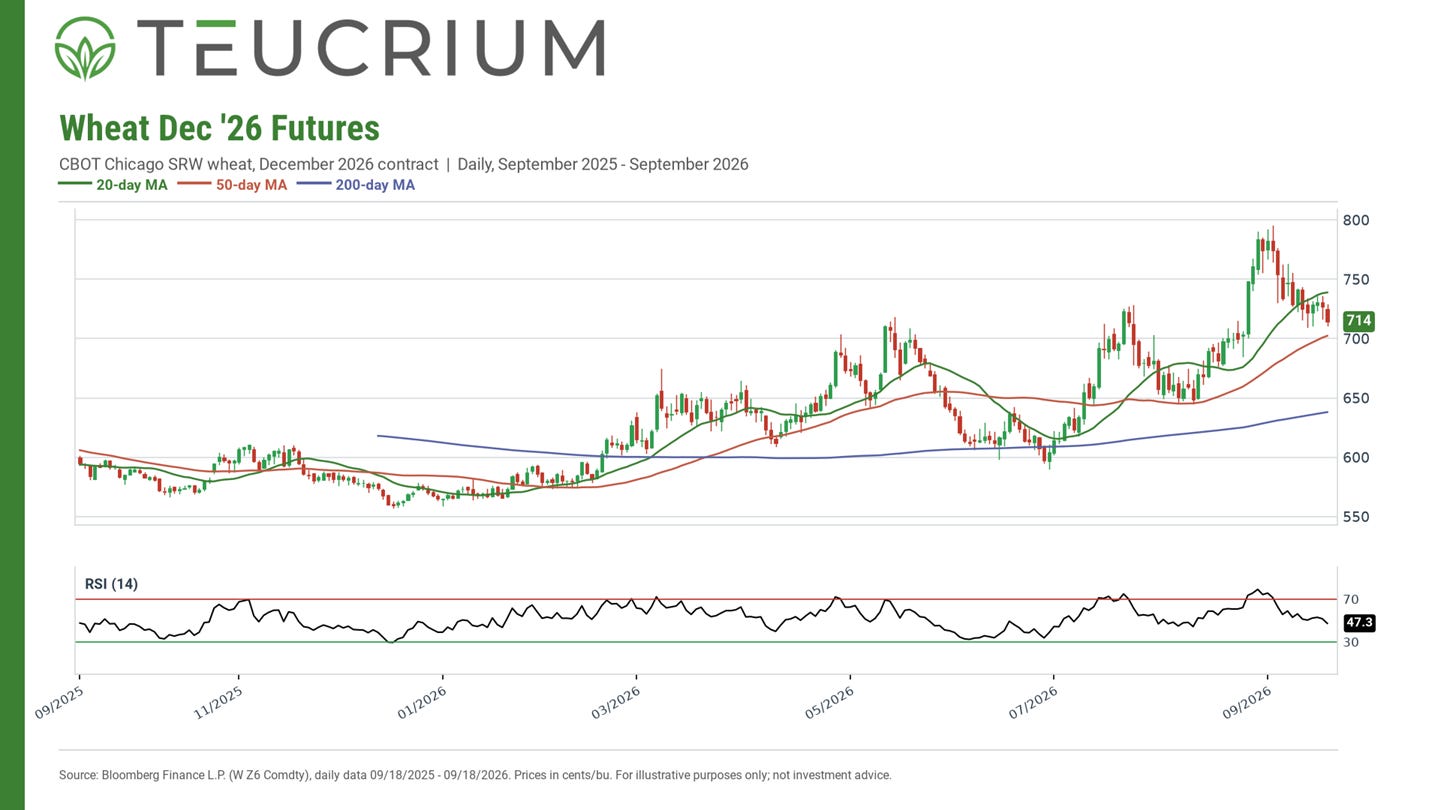
December Chicago wheat settled at $7.14 1/4 Friday, down 12 3/4 cents, and lost 11 cents on the week, a three-week low close and the third straight weekly decline off the August 28 high. December Kansas City fell 10 3/4 cents to $7.83 3/4 and was down 14 3/4 on the week. December spring wheat settled at $7.41 1/4, down 3 3/4 on the week.
Wheat fell on peace headlines all week while the strikes continued and Black Sea loadings stayed low. Monday, President Trump said Russia and Ukraine had agreed not to strike each other’s energy infrastructure, and wheat sold off.
Castle wrote that managed money was reading US pressure as a path to de-escalation in Black Sea flows, “but only time will tell if this actually translates to an improvement on the ground instead of just a headline.” Within 24 hours Ukraine hit the Syzran refinery, on Wednesday it hit Yaroslavl, and Bloomberg reported that neither side had agreed to stop.
On the water, Russia loaded 7,400 metric tons of wheat out of the Black Sea last week against 41,000 the week before, with no vessels scheduled, and 127,000 tons out of the Baltic; StoneX’s Arlan Suderman put Russia’s September exports at roughly 40% of normal, routed through the Caspian and the Baltic, with Ukrainian wheat and corn exports near zero.
Vaclavik described Moscow subsidizing rail to Baltic and Far East ports and weighing a suspension of export duties, while USDA still has Russia as the world’s top exporter. And yet, in Suderman’s words, “we still have too much wheat in the United States and cheaper alternative sources are currently filling the void.”
Bulfer counted more world tenders (Pakistan 750,000 tons, Jordan, Algeria, Indonesia) and noted the US isn’t competitive in wheat. Weekly export sales of 325,900 tons were up 68% from a marketing-year low but accumulated sales are still down 31% on the year.
The dollar rose to a seven-week high, which raises the price of US wheat for foreign buyers. Funds sold into the decline: managed money flipped to a net short of 3,674 Chicago contracts as of Tuesday, down 8,547 on the week from a small net long, and cut KC to a net long of 44,413. The Wednesday-to-Friday selling isn’t in that data yet.
Three supply problems are still building while the market appears fixated on the Black Sea headlines. Saskatchewan had harvested 27% of its cereals as of September 7 against a 58% average, Alberta 21% against 44%, and every additional day the crop stands in a wet field raises the quality risk on a Canadian crop StatsCan already trimmed to 36.1 million tons from 40.6 last year.
World Weather says parts of France have seen less than 25% of normal rain since mid-March, with drought spreading through the Balkans into Ukraine and threatening this autumn’s winter grain plantings. US winter wheat planting is 8% done against 12% on average, and Castle points out Oklahoma and Texas subsoil moisture is the lowest for the week since at least 2015. Farmers have a reason to plant anyway: July 2027 Chicago futures averaged $7.51 and KC $8.11 during the crop-insurance discovery period, both four-year highs.
Watch for the Pakistan tender award, Turkey’s attempt to broker grain shipments with both Black Sea parties, and the CFTC data for whether the fund exit continued into the break. A corridor deal could pressure prices further; a renewed strike on shipping, like Russia’s attack on 4 Ukrainian dry cargo vessels Friday, could reverse the week quickly.
Corn
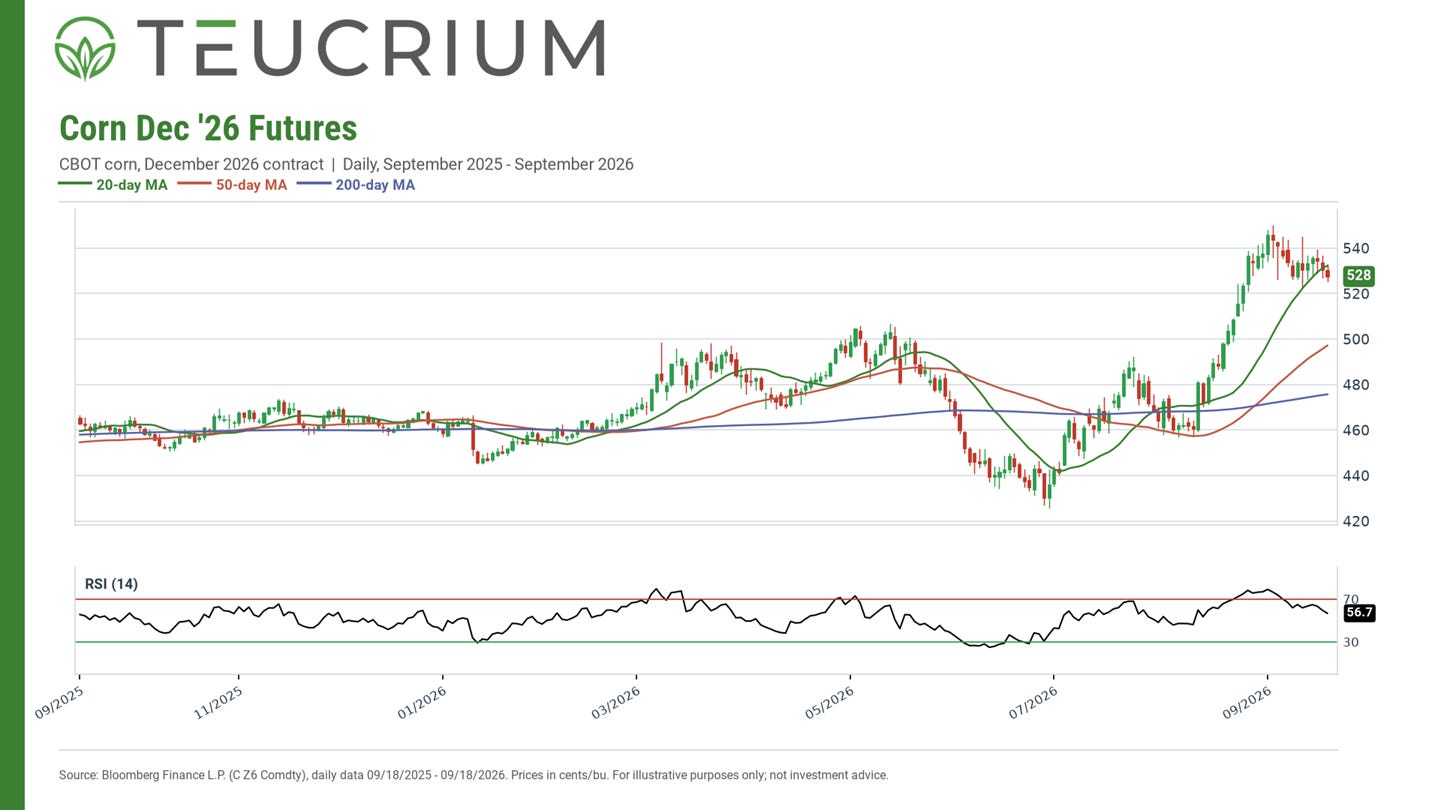
December corn settled at $5.27 1/2 Friday, down 3 cents, and finished the week down 2 3/4 cents, a three-week low close. It was the quietest of the 4 markets we track: the week’s settles ran from $5.27 1/2 to $5.35 3/4. Pro Farmer called Friday a technically bearish weekly low close that could set up follow-through chart selling early next week; the September 2 contract high of $5.49 3/4 is still intact.
Traders are still working through last Friday’s USDA report, and Suderman went through it line by line in his Friday midday note. USDA cut the corn yield 2.2 bushels to 178.5 and cut production about 200 million bushels. It then cut feed use by 150 million bushels, which offset most of the smaller crop. That leaves 2025-26 feed use at 6.350 billion bushels, nearly 900 million more than last year. Suderman’s point is that hogs, cattle and poultry did not eat 900 million more bushels. The only way the feed number works is if last year’s crop was bigger than USDA said, by roughly 400 million bushels.
He doesn’t expect NASS to admit that much in the September 30 stocks report, guessing at something under 100 million with the rest coming out of feed and residual over time. On this year’s crop, the history he cites points the other direction: in the 8 years of the past 30 when USDA cut yield in both August and September, the final came in above the September number 7 times, by 2.4 bushels on average.
Pro Farmer’s economists argue the opposite, that USDA’s implied ear weight of 0.365 pounds is still the third highest ever and a slip to the 10-year average would put yield near 173. Cordonnier held 177. Traders largely ignored the argument because harvest progress is setting the price now: 8% done as of Sunday, conditions up a point to 57% good to excellent, and a wet week behind it, with up to 5 inches in parts of Iowa, 2 to 4 more forecast from South Dakota to Wisconsin and 10 inches possible in southeast Minnesota.
Bulfer’s midday notes described the same pattern every day: no fresh news, algos running the daily trade, specs buying breaks, and funds holding a record long because “they believe the markets can’t break.” That long was 414,460 contracts as of Tuesday, unchanged on the week and, per Vaclavik, above the 409,000 record from 2011.
Export Demand was mixed. Weekly sales fell 47% to 1.0 million metric tons, less than expected, though Mexico keeps buying and Korea took 264,000 tons across 3 tenders; ethanol held at 1.099 million barrels a day with stocks at a 19-week high; France’s corn is rated a record-low 23% good to excellent and the IGC trimmed the world crop 4 million tons.
Costs are rising for the people who grow and ship corn. Diesel hit a record $6.45 a gallon Friday, rail fuel surcharges have climbed 153% in a year to 11% of the rail bill for corn and beans, and elevators are passing that through in basis. Bulfer noted many farm advisers are telling growers not to sell, and Friday’s weakness caught the bulls off guard even as they stayed bullish.
Watch Monday’s crop progress for harvest pace against the rain, the September 24 reopening of the Santa Teresa cattle crossing (about 40% of Mexican feeder imports in 2024, a feed-demand input), and the September 30 Quarterly Stocks report, where Suderman’s argument gets tested.
If prices keep falling while harvest arrives on schedule, funds selling that record long position could push the decline further and faster than the supply and demand numbers alone would; a return of Chinese buying at next week’s summit, or a stocks number that validates the tight balance sheet, might do the reverse.
Sugar
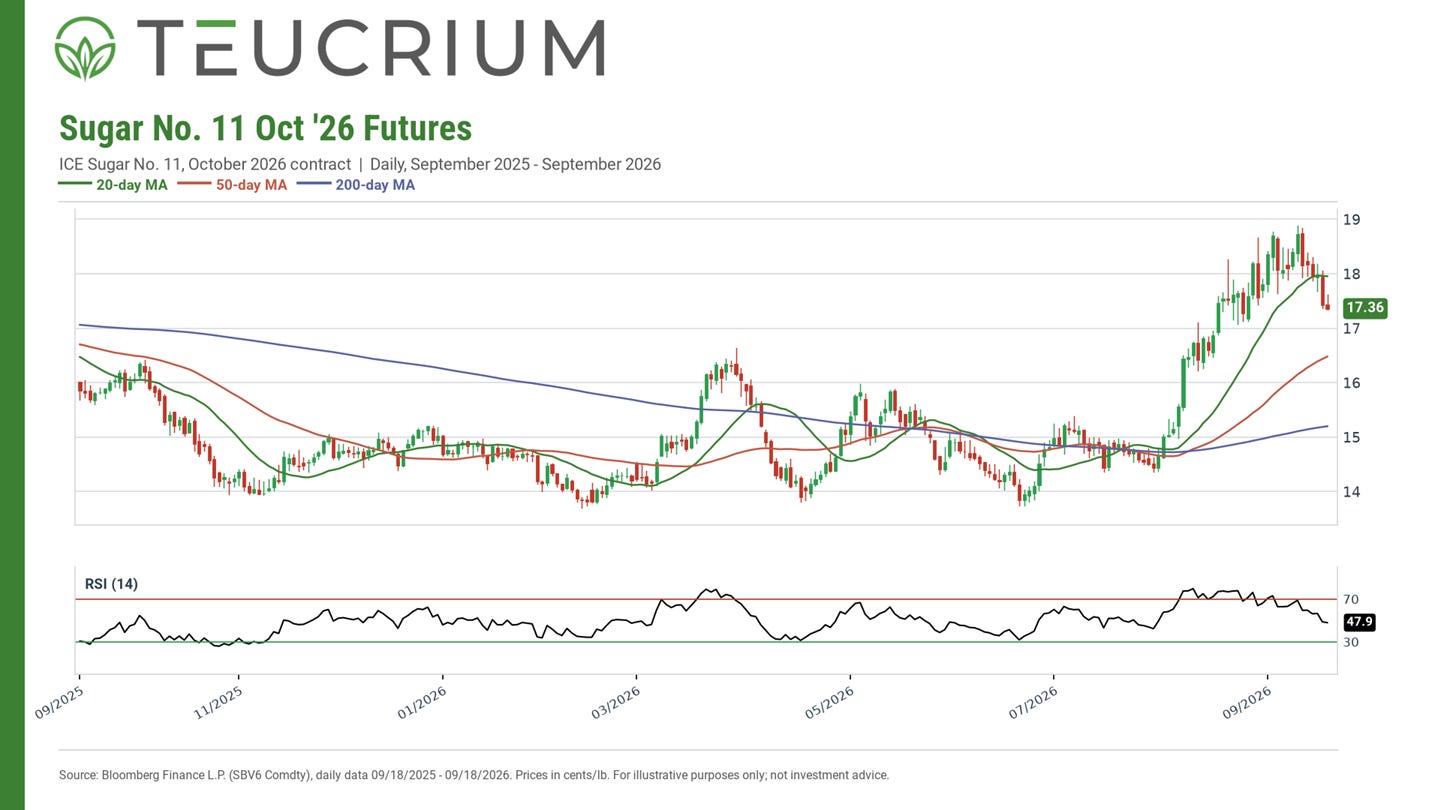
October Sugar No. 11 settled at 17.36 cents Friday, down 6 points, and lost 79 points, or 4.4%, on the week. Most of the week’s loss came Thursday, a 55-point, 3.1% drop to 17.42, a three-week low, one week after the September 10 settle of 18.73 that was the highest for a front month since April 2025. March, which becomes the front month when October expires on September 30, settled at 18.24, down 89 on the week.
Funds were selling a long position they had only just built: in about five weeks the market went from a fund net short to a 17-month high. Managed money was net long 225,430 contracts as of Tuesday, down 13,254 from a prior-week peak that was the largest since January 2023 (CFTC history), and that was before Thursday. Funds were net short sugar in 47 of the past 53 weekly reports and only flipped long in the August 11 report, so these longs are recent and quick to sell.
The delivery data gave them a reason to sell: 499,350 metric tons were delivered against the London October white sugar expiry Tuesday, up 91% from a year ago, which reads as weak refined demand at these prices. Falling crude added to the selling: WTI traded below $100 Thursday, and cheaper oil makes ethanol less profitable than sugar for Brazilian mills, whose switch to ethanol has been the supply-side reason for the rally.
Brazilian sugar supply did not improve this week. Brazil’s Agriculture Ministry data, filling in for the UNICA reports that have stopped arriving, showed Center-South sugar output down 4.8% in the second half of August to 3.72 million tons and down 10.7% for the season to 23.95 million, with ethanol output up 13.2%. Rain has slowed crushing, is limiting recoverable sugar, and may push the season into December or January. India’s monsoon is 15% below normal, on track for the weakest since 2009 if the deficit holds, and Maharashtra’s sugar commissioner says the state’s 11.2 million ton estimate will be revised before crushing starts October 15. India is also pushing back on price. New Delhi’s stock limits and a 2.65 million ton September sales quota have pulled retail prices below INR 60,000 a ton, and the government extended the deadline for mills to surrender unused import quotas to September 30 because domestic prices fell while world prices rose, so those imports may not come. China imported 650,000 tons in August, its biggest month this year but still 21% below a year ago.
Watch the October expiry on September 30 and the size of the delivery against it, India’s same-day deadline for mills to surrender unused import quotas and whatever export policy follows for a 2026-27 season with a smaller crop, and whether drier weather lets Brazilian mills make up the lost crushing days before they shut down for the wet season in December.
Two smaller supply stories are worth tracking: Indonesia’s plan to put 2 million hectares into cane for E20, and Pakistan’s fight over exporting 200,000 tons versus the 1 million tons its mills want.
Sugar prices follow the dollar and crude oil as much as the cane crop, and with the dollar at a seven-week high and funds still long more than 225,000 contracts, further liquidation could pressure prices toward the 50-day moving average near 16.48 cents.
A dry end to the monsoon or another cut to Brazilian output might bring the buyers back.
See how money managers are positioned. Check out our CFTC Managed Money Monitor here: https://teucrium.com/cftc_managed_money_monitor