Sugar
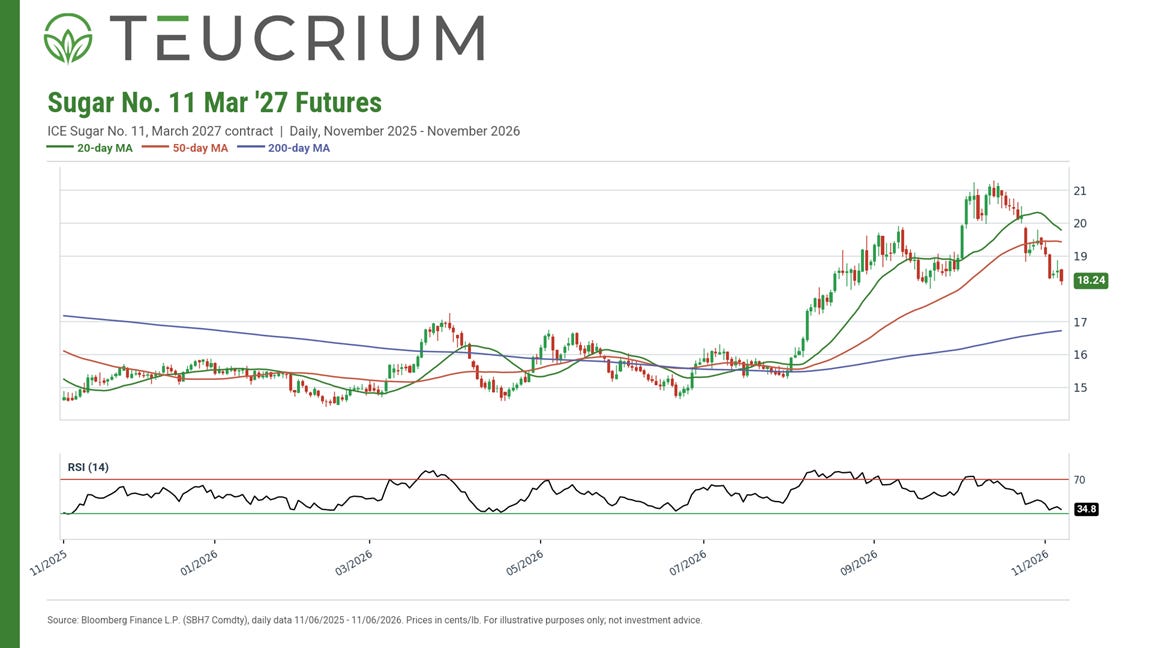
March raw sugar (ICE No. 11) settled at 18.24 cents per pound on Friday, down 0.32 cent on the day and 1.12 cents, or 5.8%, on the week. That’s the 3rd straight weekly loss and the lowest settle since August 17.
WTI crude oil fell 12.8% on the week, to $90.83 a barrel from $104.12. Democrats won both the House and Senate in Tuesday’s midterms. The prevailing thought according to Pro Farmer’s Bill Watts is that renewed escalation with Iran is now less likely. Oil dropped about 9% on Wednesday.
Oil matters to sugar through Brazil’s mills, which can steer cane toward sugar or ethanol. Novacana, the Brazilian sugar and ethanol news service, reported that the price mills get for hydrous ethanol in São Paulo rose 37.6% in the 3 months through October 30 as rain delayed the cane harvest. Cheaper gasoline could erode that ethanol bid and push mills to switch more cane to sugar next season.
Rabobank, the Dutch agricultural lender, is forecasting Center-South Brazil’s 2027/28 sugar output at 42.6 million metric tons, up 13.9% from this year’s 37.4 million, on a 655 million ton cane crush. Some of that output is likely to come from cane that will be left in the fields this year due to excessive moisture.
At a Datagro event (Datagro is the São Paulo sugar and ethanol consultancy), commodity merchant Louis Dreyfus and sugar trader Sucden Brasil estimated that 30 million to 60 million tons of cane will be left standing in the field this season and carried into next year’s crush.
In India, ISMA, the Indian Sugar & Bio-Energy Manufacturers Association, the mills’ trade group, counted 1.29 million tons of sugar produced through November 5, up from 0.32 million a year earlier, with 184 mills running and about 3.6 million tons carried in from last season.
The Brazilian real weakened another 1.4% on the week, to 5.52 per dollar. This encourages mills to sell sugar for dollars as the weaker exchange rate results in more local currency for every pound exported.
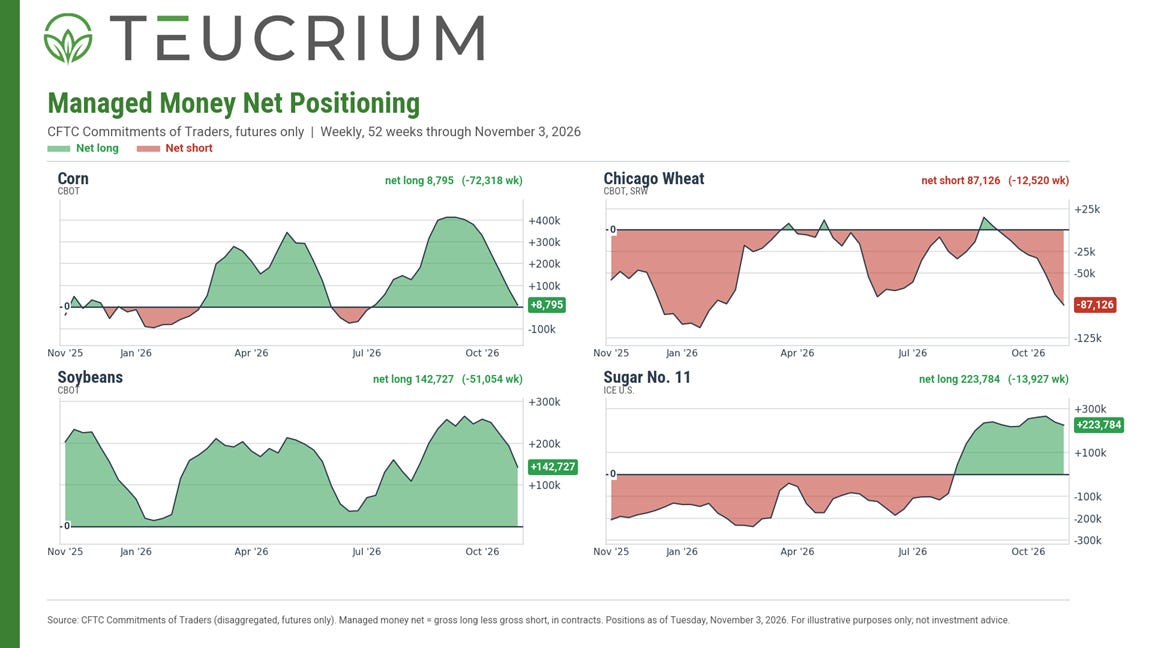
Managed money (hedge funds and commodity trading advisors, per the CFTC’s weekly Commitments of Traders report) was net long 223,784 contracts as of Tuesday, down 13,927 on the week and about 40,700 below the 52-week high of 264,530 set October 20. If those funds keep selling as prices fall, the decline could extend. Rabobank still sees a 2 million ton global deficit in 2026/27 and a 2027 raw sugar range of 17 to 19 cents, so the bank’s own outlook leaves room for prices to stabilize near current levels. Watch crude oil and the Iran headlines first. Then watch UNICA, the Center-South cane industry association, for its report on the second half of October, which may show whether drier weather let the mills catch up on the crush.
Soybeans
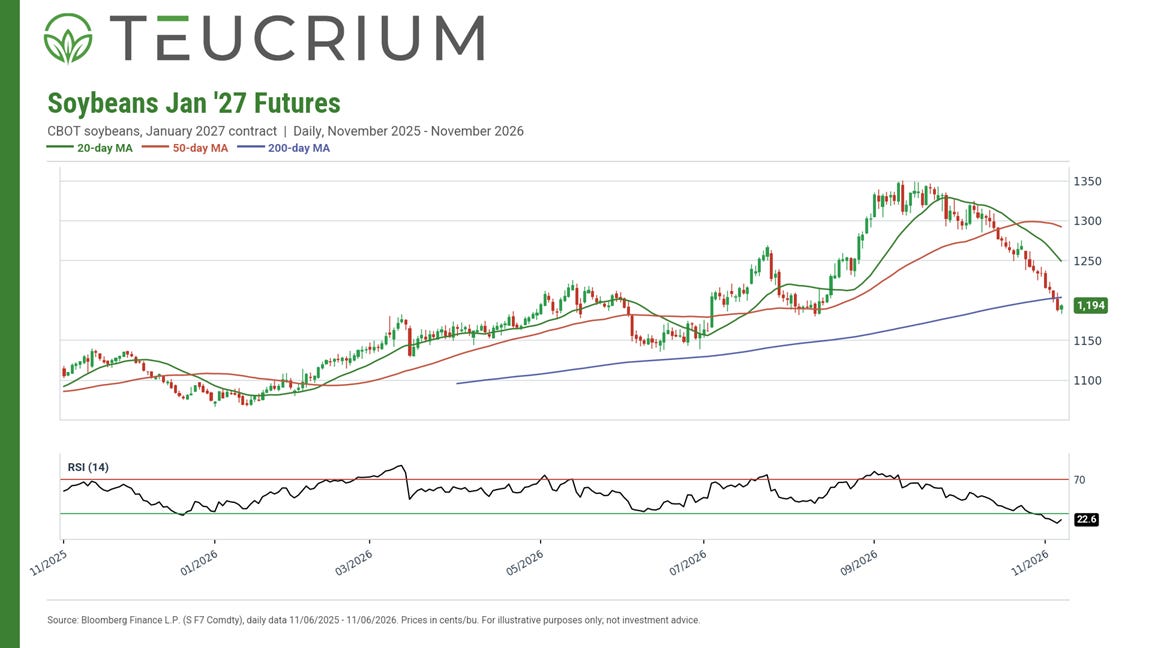
January soybeans settled at $11.93 3/4 on Friday, up 5 1/2 cents on the day and down 40 1/2 cents, or 3.3%, on the week. Friday’s gain ended a 9-session losing streak. December soybean oil lost 3.64 cents, or 5.5%, on the week to 62.26 cents and hit a 6-week low. December meal lost $5.40 to $319.20.
StoneX, the commodity brokerage, ran a customer survey that Arlan Suderman wrote up Wednesday. It put the US soybean yield at 55.0 bushels per acre, up from 54.1 in October and well above USDA’s October record of 53.1. The trade’s average guess, as compiled in Friday’s morning comment from Charlie Sernatinger, who writes the morning grain notes at brokerage Marex, is more modest: 53.5 bushels, 4.597 billion bushels of production and ending stocks of 331 million against USDA’s 315 million.
Suderman found that USDA raised its soybean yield in the October report 13 times since 1993 and raised it again in November in 11 of those years, by an average of 0.82 bushel. Falling crude oil hit soybean oil, since it’s a biofuel feedstock, and the soy complex followed.
USDA reported net sales of 1.5 million metric tons for the week ended October 29, down 44% from the week before, with China the largest buyer and cumulative sales up 76% on the year. USDA also announced 136,000 tons sold to China on Friday. Funds cut their net long by 51,054 contracts to 142,727 as of Tuesday, the 4th straight weekly cut and the smallest long since August 11.
USDA’s November supply and demand report (WASDE) comes out Tuesday, November 10. A yield near StoneX’s 55 bushels could add pressure, while a number closer to the 53.5 trade guess might give short covering more room. Marex relayed that the US agricultural attaché in Beijing pegged China’s 2026/27 soybean imports at 110 million tons, 5 million below USDA, and that China will offer 203,000 tons of reserve soybeans at auction on November 10. Both could lower expectations for Chinese buying even with the sales pace running ahead of last year.
Wheat
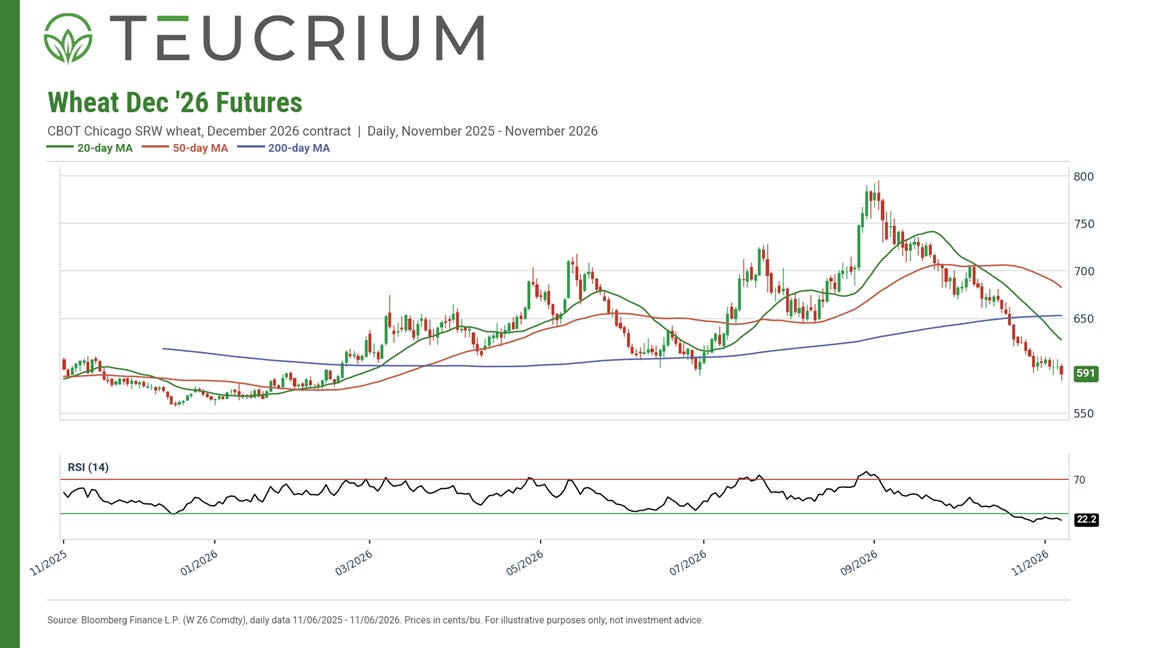
December Chicago soft red winter wheat settled at $5.91 1/4 on Friday, down 8 cents on the day and 12 1/4 cents, or 2.0%, on the week. That’s the contract’s 10th straight weekly loss and its lowest settle since February 18.
The Kremlin confirmed Tuesday that Russia, Ukraine and the US will hold 3-way peace talks in Abu Dhabi on November 10 and 11, per a Reuters report, and Pro Farmer wrote that the talks have removed the war premium from wheat even though hopes for a breakthrough remain low.
StoneX’s Mike Castle doubts the talks will reopen Black Sea shipping soon, because Russian officials keep tying any maritime deal to sanctions and agricultural trade.
US export sales were 538,000 tons for the week ended October 29, and cumulative sales are down 28% from last year. Vaclavik flagged $600 million in sorghum and wheat purchase agreements that Hang Tung Resources, an Illinois grain exporter, signed with 3 Chinese buyers Friday, though he noted China hasn’t officially bought any US wheat this year. Funds added 12,520 contracts to their Chicago net short, which reached 87,126 as of Tuesday, the 9th straight week of selling and the largest net short since January 27.
The 14-day relative strength index on December Chicago wheat sits near 22, deep in oversold territory, and Tim Bulfer, who heads grain futures sales at Marex, wrote Friday that many traders “simply can’t sell these price levels.” A fund short that size could fuel a sharp short-covering rally if the Abu Dhabi talks stall or the fighting spreads to Black Sea ports. A deal that reopens shipping would likely push prices the other way. Watch the talks Monday and Tuesday and USDA’s wheat ending stocks Tuesday, where the trade’s average guess is 746 million bushels against 740 million in October.
Corn
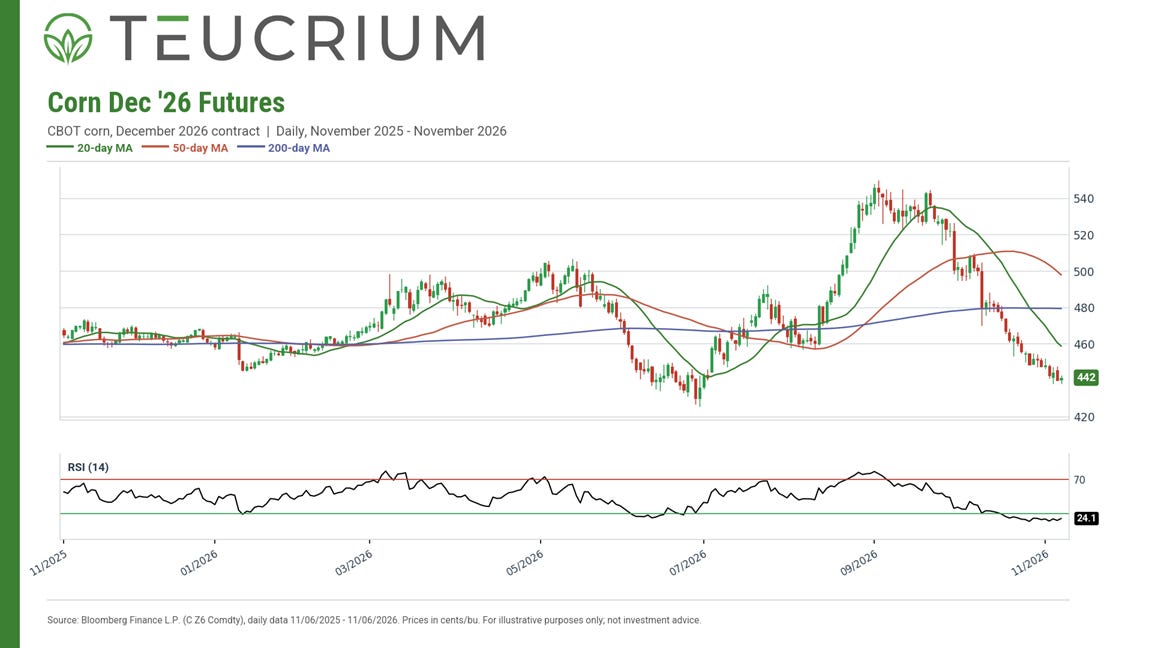
December corn settled at $4.41 1/2 on Friday, up 1 1/2 cents on the day but down 6 1/4 cents, or 1.4%, on the week. That’s the 6th straight weekly loss.
Managed money cut its corn net long by 72,318 contracts to 8,795 as of Tuesday, the 7th straight weekly cut and the smallest long since July 7. The 52-week high was 414,460 contracts on September 15, so funds have sold about 405,000 contracts in 7 weeks.
Pro Farmer’s Hillari Mason pointed to the same pattern from May to June, when funds went from a 343,925-contract net long to a 69,691 net short and December lost 70 3/4 cents.
StoneX’s survey put the corn yield at 183.1 bushels per acre, above USDA’s 181.2 in October, and Suderman found that when USDA raised the yield in October (17 times since 1993), it raised it again in November 12 times, by an average of 1.86 bushels. The trade’s average guess, per Marex, goes the other way: 180.3 bushels, 15.961 billion bushels of production and ending stocks of 1.840 billion. Net export sales were 1.3 million metric tons for the week ended October 29, and cumulative sales are down 34% on the year, per Standard Grain. USDA did announce flash sales of 315,000 tons to Mexico and 136,000 tons to South Korea on Tuesday.
A yield near the 180.3 trade guess might support prices in Tuesday’s report, while a USDA estimate closer to StoneX’s 183.1 could result in additional selling pressure.
With funds close to flat, there’s less long position left to sell. Matt Zeller, StoneX’s senior grains analyst, wrote that the rain has moved out and the harvest is set to resume across the Corn Belt next week, which may bring more farmer selling. Watch the stock market too. Pro Farmer wrote that corn bulls may stay on the sidelines if stocks keep falling.