See how money managers are positioned. Check out our CFTC Managed Money Monitor here: https://teucrium.com/cftc_managed_money_monitor
Corn
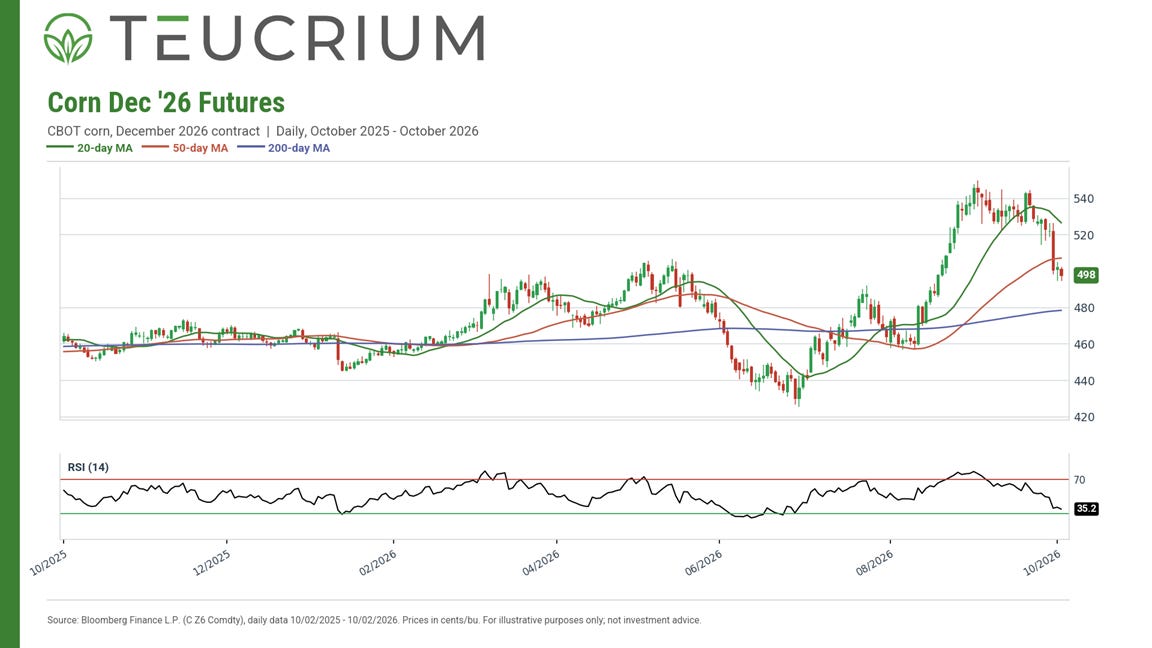
December corn settled at $4.97 3/4 on Friday, down 5 cents on the day and down 30 1/2 cents on the week, a 5.8% drop and the lowest close since mid-August. Most of the damage came Wednesday, when the contract fell 21 1/4 cents to $5.00 3/4 in the hour after USDA’s Quarterly Grain Stocks report.
USDA pegged September 1 corn stocks at 2.095 billion bushels. The trade expected 1.918 billion, and the highest guess on the street was 2.005 billion, so the print cleared every estimate by at least 90 million bushels and came in 173 million above the September WASDE carryout.
The 2025 crop was trimmed only 57 million bushels, to 16.964 billion, all from harvested acres, leaving the difference to be subtracted from demand estimates.
Standard Grain’s Joe Vaclavik expects the October 9 WASDE to cut old-crop feed and residual from 6.350 billion bushels to something near 6.118 billion, and Marex’s Tim Bulfer called it “a bearish shocker, the second year in a row for that.”
The funds were still long 381,220 contracts as of Tuesday, September 29, down 22,877 on the week but only about 33,000 off the mid-September peak of 414,460, which is the largest managed money long in the 52 weeks we track.
The report hit a market that was already leaning the wrong way, and the Wednesday-to-Friday liquidation isn’t in those numbers yet. Pro Farmer’s Spencer Langford made the measured case: with the bigger carry-in, 2026/27 stocks-to-use sits near 10.7%, roughly in line with the 5-year average, so most of the [price] damage from the stocks number has probably been done.
Demand elsewhere held up. August corn grind for ethanol was 477.7 million bushels, wrapping the marketing year at an 8-year high, and export inspections are running at their fastest start in 10 years even as cumulative sales lag last year by 31%.
Watch for the October 9 WASDE, where the new carry-in meets a potential updated yield number. StoneX came out Friday at 182.1 bushels per acre and a 16.115 billion bushel crop, above USDA’s September 178.5. If USDA moves that direction the market may struggle to hold $5.
Harvest is 18% done nationally but only 5% in Iowa after a record-wet September, and the forecast turns dry for 2 weeks starting this weekend, so harvest pressure could build just as the fund long is being unwound.
A WASDE yield projection cut toward the Pro Farmer Crop Tour’s 173.2 would likely be the first thing that could turn this market back around.
Sugar
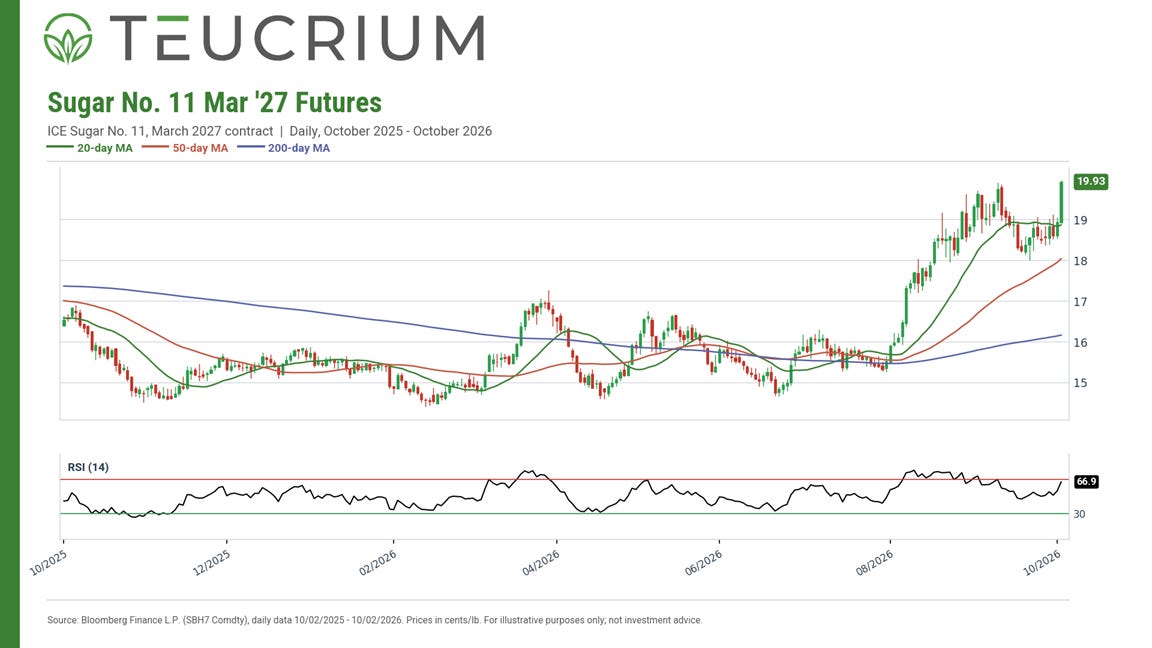
March raw sugar settled at 19.93 cents per pound on Friday, up 0.99 cents or 5.2% on the day, and up 1.43 cents or 7.7% on the week. The October contract expired Wednesday, so March is now the front month. Friday’s close is the highest for raw sugar since April 2025 and it cleared the early-September high on a single candle.
Brazil is the story, and the trade is keeping a close eye on the weather.
Datagro’s Plinio Nastari estimates excess rain in the Center-South may leave a record 35 million metric tons of cane standing in the fields at the end of the season, more than the 24 million tons left over in 2015/16, with milling now likely to run into February or March.
Wet cane also carries less recoverable sugar, which suggests a higher allocation toward ethanol. StoneX’s sugar desk told Reuters that Center-South sugar output may not reach 38 million tons against the 40 million the market started the season expecting, and that mills had put just 42.5% of cane into sugar through early July.
Conditions in India are adding to the bull case as well reporting the weakest monsoon in a decade, 12.6% below average, with Uttar Pradesh output down from 12.64 million tons to 8.95 million over 6 years on red rot, and a government importing 1 million tons and forcing Maharashtra mills to start crushing 2 weeks early to get stock on shelves before Diwali.
Trading Economics relayed a StoneX forecast of a 900,000 ton global deficit for 2026/27, with Thai output seen down at least 17% and EU output down 19%.
Funds were long 218,336 contracts as of Tuesday, up 1,707 on the week and close to the 238,684 peak from September 8; sugar was net short 238,217 in early March, so this is a complete round trip in 7 months. The FAO’s food price index rose to its highest since November 2022 in September, led by grains and sugar.
Watch for Unica’s second-half September crush report and the sugar mix in it, which would confirm or undercut the Datagro and StoneX numbers. A dollar at a 1.5-year high and crude down 3% Friday both lean against sugar on paper, since cheaper crude narrows ethanol parity, and the market rallied through both of them. If the Center-South dries out in October and mills manage to lift the sugar mix, prices could give back part of this move quickly given how crowded the long is.
If the rain keeps up, the deficit math may get worse before it gets better.
Soybeans
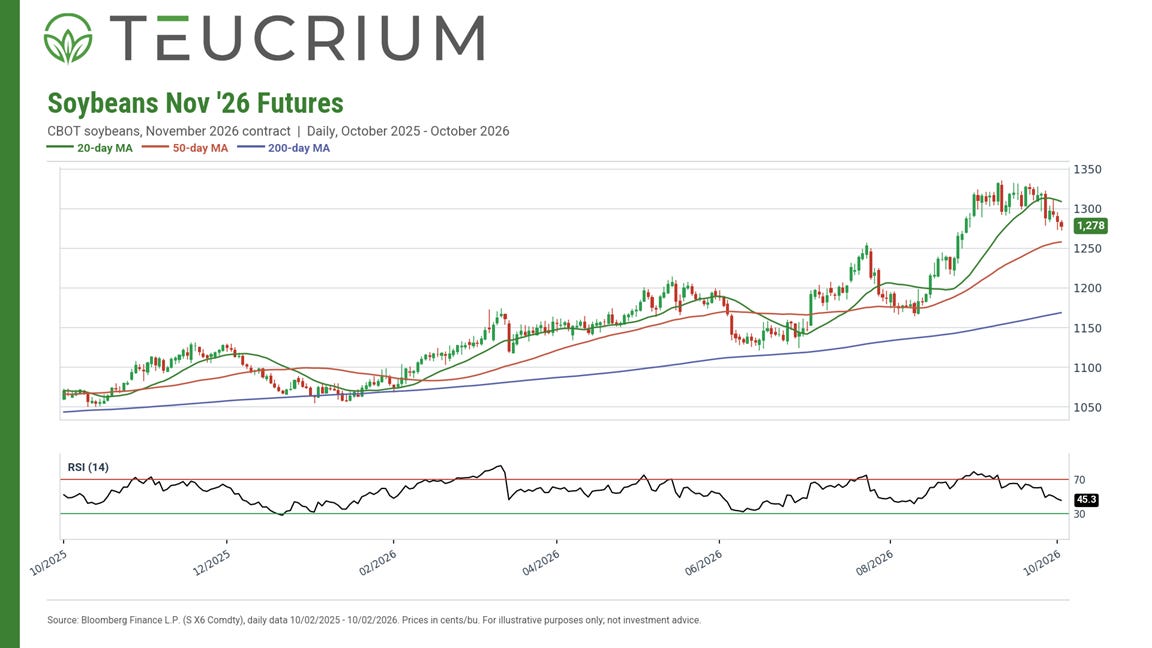
November soybeans settled at $12.78 1/4 on Friday, down 6 3/4 cents on the day and down 40 3/4 cents on the week, a 3.1% decline to a 4-week low. The majority of the selling occurred on Monday as prices fell 30 3/4 cents to $12.88 1/4 after soybeans were left off the list of US farm goods getting tariff relief out of the Trump-Xi summit.
China cut tariffs on roughly $30 billion of US goods, including corn, wheat, sorghum, beef and pork, and kept the 10% retaliatory tariff on soybeans in place. StoneX’s Mike Castle read it as a negotiating tactic: Beijing is willing to meet its 25 million metric ton annual pledge with state buyers, who are already past the halfway mark, but it isn’t ready to open the trade to private crushers. Reuters reported those private crushers have covered needs through the Lunar New Year with South American beans and state reserves, so Chinese buying could slow from here.
The demand data still looks good.
Weekly export sales of 1.03 million tons beat the top estimate, cumulative sales of 817 million bushels are nearly double last year and the strongest in 4 years, and inspections of 42.4 million bushels were the largest since February with 70% going to China. Still, the headlines (or lack-thereof) matter more and the funds had their reasons to sell.
The managed money net long fell 18,601 to 246,558 contracts as of Tuesday, with 280,875 longs against just 34,317 shorts. That is still up 11,638 over 4 weeks and in the 94th percentile of the past 52 weeks
Watch for the StoneX yield number to work its way into the trade. They raised their US soybean yield to 54.1 bushels per acre and production to 4.648 billion bushels, against USDA’s 52.8 and 4.535 billion, and a crop that size would likely cap rallies regardless of what China does.
Harvest progress is only 3% in Iowa against a 17% national average, and processors in the western Corn Belt were paying 60 to 85 cents over futures for immediate delivery, so the cash market is tight even as futures fall.
The November roll starts next week with the funds still long November, which could add some chop to the trade.
Trump and Xi meet again in November and December, and the 10% tariff is the number to watch at both.
Wheat
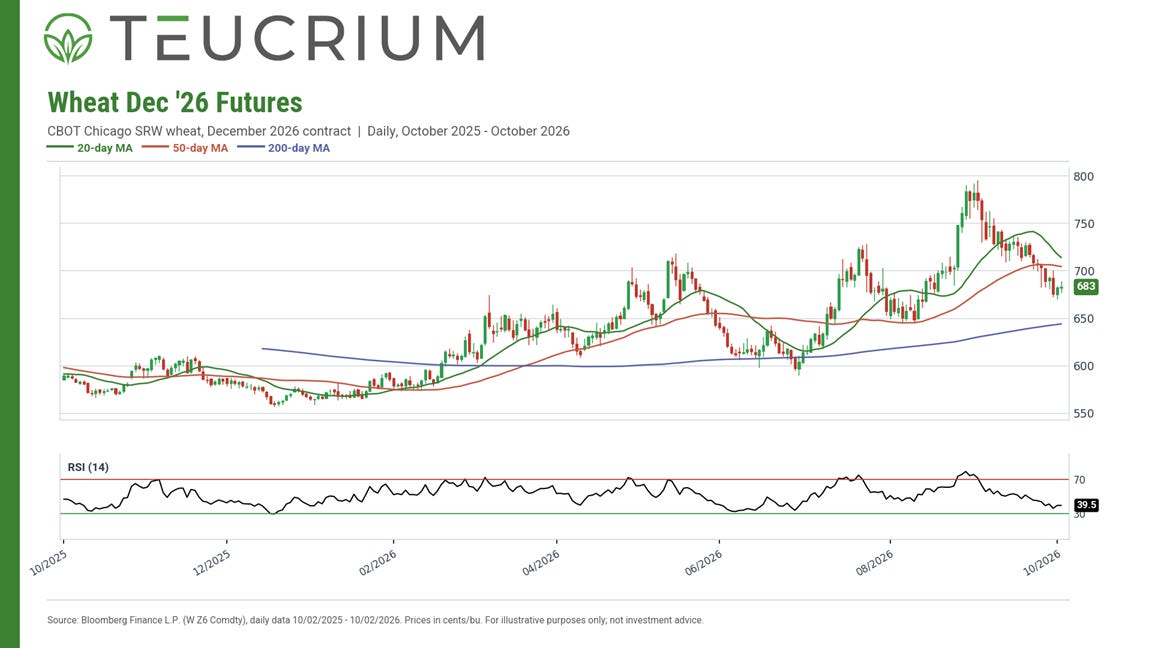
December Chicago wheat settled at $6.83 on Friday, up a quarter cent on the day and down 20 1/4 cents on the week, a 2.9% drop. Kansas City December lost 26 3/4 cents to $7.35 1/4 and Minneapolis December lost 15 1/2 cents to $6.98. Chicago touched a 6-week low of $6.75 3/4 on Wednesday as corn’s break spilled over, and then spent the rest of the week trying to stabilize.
The USDA numbers were neutral for wheat.
September 1 stocks of 1.845 billion bushels came in 44 million under the trade estimate, and all-wheat production of 1.534 billion bushels was barely changed from August, down 23% from last year.
Prices however, are likely finding some support against a geopolitical situation that hasn’t improved. SovEcon cut its Russian wheat export forecast by 4.7 million metric tons to 36.7 million, 20% below last year and the lowest since 2021/22, and said Azov and Black Sea ports will stay shut through year-end.
Russia moved 81,000 tons of wheat through the Black Sea last week when it should be clearing 8 times that.
The FAO says world wheat prices rose 6.3% in September to the highest since August 2023. Chicago futures price fell anyway, due to poor US export sales which are 31% behind last years pace.
StoneX’s Castle said the market still needs to see demand actually shift to US origin before it pays for the Black Sea story, and this week’s data didn’t deliver that. Managed money flipped to a net short of 22,109 Chicago contracts as of Tuesday, 10,093 more sold on the week, while Kansas City held a 30,677 long and Minneapolis 16,206. Marex notes the funds are now expressly long corn and short wheat in size.
Watch for the winter wheat planting to catch up. It was 27% done against a 34% average, the slowest start on record, but the Plains just had their wettest comparable week since 2017 and the forecast is dry for 2 weeks, which could mean a planting surge into improved soil moisture.
Saudi Arabia tendered for 535,000 tons for November-December and Korea, Taiwan and Jordan are all in the market; where that business lands would say a lot about whether US wheat is competitive at these prices. Bulfer’s read is that continued liquidation in corn could put a bid under Chicago wheat as the long corn/short wheat spread unwinds. However If the dollar continues strengthening, that bid may not amount to much.