

A trader studies their screen:
- Corn futures are hovering around $4.20.
- Wheat has retreated from recent highs.
- Soybeans are building inventory.
The real question for many traders: where are we in the cycle, and what happens next?
Stocks are driven by quarterly earnings. Bonds track interest rate expectations. But grain markets follow earthly fundamentals: our planet’s tilt toward the sun, single annual harvests in North America, and the eternal tension between what farmers plant and what the world consumes.
Teucrium’s Golden Grain Cycle provides the pattern recognition framework every ag trader needs. As Teucrium CEO Sal Gilbertie articulates: “Grains tend to trade at or near their cost of production until there is a supply disruption. At which point, prices historically have moved dramatically higher.” He continues: “Over time, as production increases and/or demand decreases, inventories are rebuilt. And prices trend back toward the cost of production once again.”
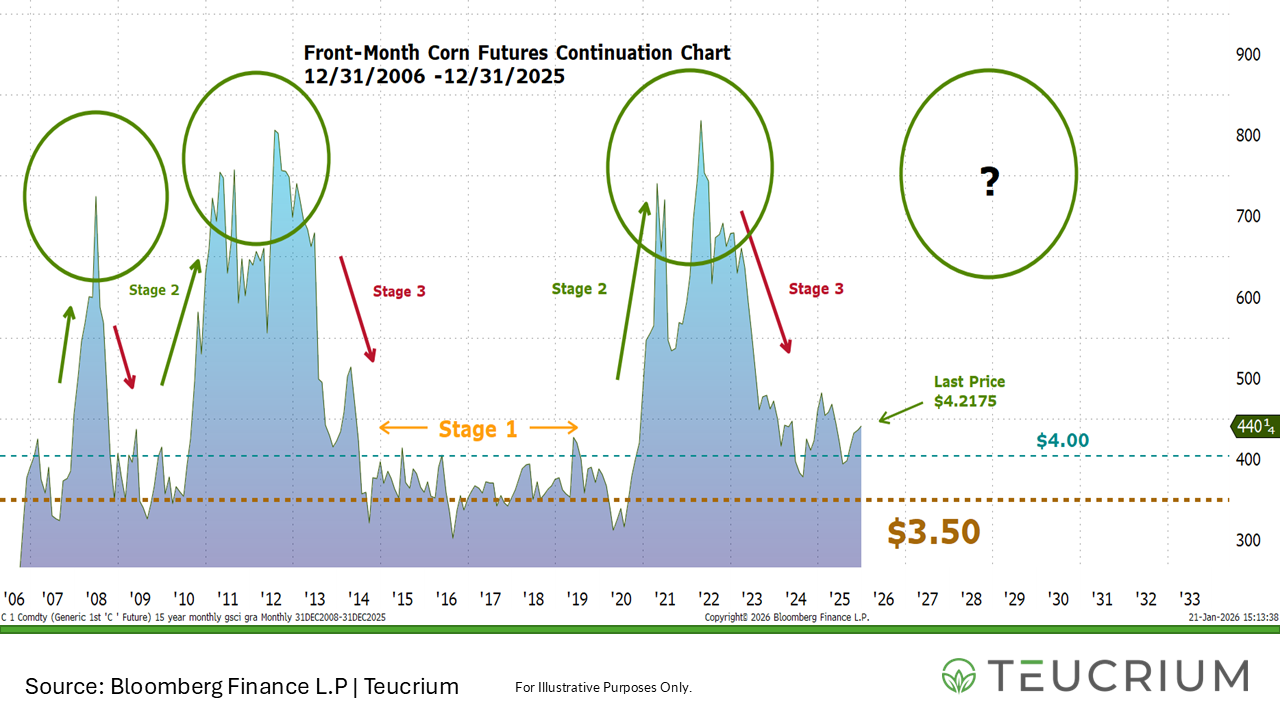
Three doublings in 17 years tell a concrete story. Front-month corn futures have doubled three times from Stage 1 levels since 2006. Understanding which stage you’re observing determines whether you’re positioned for opportunity or absorbing unnecessary risk.
%20Evaluating%20the%20Cyclical%20Performance%20quote.png?width=2354&height=431&name=57154%20TEC%20-%20RIA%20Blog%208%20(MOFU)%20Evaluating%20the%20Cyclical%20Performance%20quote.png)
What Is the Golden Grain Cycle's Three-Stage Framework?
The Golden Grain Cycle operates through three distinct stages, each with recognizable characteristics and tradable implications.
%20Evaluating%20the%20Cyclical%20Performance%20Golden%20Grain%20Cycle.png?width=2354&height=840&name=57154%20TEC%20-%20RIA%20Blog%208%20(MOFU)%20Evaluating%20the%20Cyclical%20Performance%20Golden%20Grain%20Cycle.png)
Stage 1: Prices at or Near Cost of Production
The cycle begins where economic gravity pulls prices toward the cost of production. Historically, this floor has been about $3.50 per bushel for corn futures, equivalent to the national average production cost.
In Stage 1, production exceeds demand, inventories accumulate, and farmer profit margins compress. Stage 1 represents the natural equilibrium when supply is abundant. Lower margins often result in fewer planted acres as farmers respond rationally to squeezed economics.
For traders, Stage 1 represents the setup phase. Prices near production cost may create an asymmetric risk/reward dynamic as downside becomes limited while potential catalysts build.
Stage 2: Prices Advance Amid Supply/Demand Imbalance
Stage 1’s compressed margins lead to reduced plantings. When fewer acres meet adverse weather conditions, inventories have historically tended to draw down and demand exceeds production. Prices advance, sometimes dramatically. This is the cycle’s profit phase, where patient Stage 1 accumulation pays off.
The key is recognizing the transition: watching inventory reports accelerate their drawdown, monitoring weather disruptions in key growing regions, and identifying the inflection point where a scarcity premium enters pricing.
Stage 3: Supplies Build, Prices Return Toward Production Cost
Higher prices create their own cure. Farmers respond to Stage 2 profitability by planting more acres. As production catches back up with demand, the cycle completes its arc. Prices trend lower, gravitating back toward production cost. For traders, Stage 3 recognition prevents the classic error of holding winners too long. The signals appear in USDA planting reports showing acreage expansion and harvest forecasts improving.
The cycle is “cosmic,” dictated by planetary mechanics and seasonal rhythms. But within that cosmic structure, human behavior may create additional tradable volatility.
Three Complete Corn Cycles: Pattern Recognition in Practice
Teucrium’s Golden Grain Cycle chart for front-month corn futures reveals three distinct complete cycles since 2006. Each demonstrates how different catalysts and timeframes have historically played out within this pattern.
Cycle One: 2006-2009
Stage 1 Setup (2006): Corn futures traded in the $2.00-$3.00 range through early 2006, hovering near production cost levels. Years of adequate production had built comfortable inventory buffers. Farmer margins were compressed but stable. 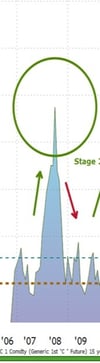
Stage 2 Surge (2006-2008): The transition began with the renewable fuels mandate creating new ethanol demand while weather concerns emerged in key growing regions. Corn futures jumped from roughly $2.00 in early 2006 to over $7.50 by mid-2008—nearly a 300% advance.
Fundamental supply/demand imbalance drove the move as the stocks-to-use ratio (calculated by dividing ending stocks by total use) tightened dramatically.
Stage 3 Return (2008-2009): The financial crisis dampened demand while farmers responded to high prices with aggressive planting. By early 2009, corn futures had retreated to the $3.50-$4.00 range, completing the cycle’s return toward production cost.
Trader Takeaway: The 2006-2009 cycle demonstrated Stage 2’s explosive potential when multiple factors converge:
%20Evaluating%20the%20Cyclical%20Performance%20Prices%20Higher.png?width=2354&height=531&name=57154%20TEC%20-%20RIA%20Blog%208%20(MOFU)%20Evaluating%20the%20Cyclical%20Performance%20Prices%20Higher.png)
Cycle Two: 2009-2014
Stage 1 Setup (2009-2010): Following the financial crisis retreat, corn consolidated in the $3.50-$4.50 range through much of 2009 and early 2010. Production had recovered, inventories were rebuilt, and prices gravitated back to production economics. 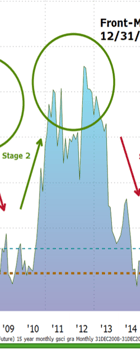
Stage 2 Surge (2010-2012): This cycle’s Stage 2 proved even more dramatic. Severe drought conditions in 2012 combined with growing Chinese demand created acute supply constraints. Corn futures surged from around $3.50 in mid-2010 to over $8.00 by mid-2012—another doubling from Stage 1 levels. The inventory drawdown was severe, with stocks-to-use ratios hitting historically tight levels.
Stage 3 Return (2012-2014): High prices triggered the predictable response: farmers planted fence row to fence row. Record acreage combined with improved weather rebuilt supplies. By 2014, corn futures had declined back toward $3.50-$4.00, completing another full cycle.
Trader Takeaway: The 2009-2014 cycle illustrated a pattern consistent with prior cycles while demonstrating that Stage 2 duration varies. The 2012 drought created a sharp, concentrated spike rather than a gradual advance. Recognizing Stage 3’s emergence—watching planted acreage reports and weather forecasts improving—was critical for profit-taking.
Cycle Three: 2014-Present
Stage 1 Extended (2014-2020): This cycle’s Stage 1 proved unusually persistent. Corn traded in a relatively narrow $3.00-$4.50 range for nearly six years. Abundant production, large carryover stocks, and stable demand kept prices anchored near production cost. For traders, this extended Stage 1 tested conviction but continuously reset the risk/reward setup. 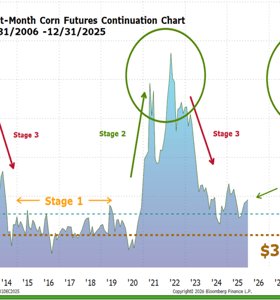
Stage 2 Emergence (2020-2022): The COVID-19 pandemic disrupted supply chains while Chinese buying accelerated. Weather concerns in South America and the Midwest created inventory anxiety. Corn surged from roughly $3.20 in spring 2020 to over $7.50 by mid-2021, the third doubling from Stage 1 levels captured in Teucrium’s data.
Stage 3 Development (2022-Present): As of early 2026, corn futures are trading around $4.20-$4.30, suggesting the cycle has entered Stage 3 territory. Farmers responded to 2021-2022 profitability with expanded plantings, and the resulting recovery in production sent prices back toward the historical $3.50 production cost floor.
Trader Takeaway: The current cycle demonstrates that Stage 1 can persist longer than expected, but the fundamental framework remains intact. The patient capital that accumulated during 2014-2020’s extended Stage 1 was rewarded with Stage 2’s eventual resurgence.
%20Evaluating%20the%20Cyclical%20Performance%20Cycle%20setup.png?width=851&height=233&name=57154%20TEC%20-%20RIA%20Blog%208%20(MOFU)%20Evaluating%20the%20Cyclical%20Performance%20Cycle%20setup.png)
Do Wheat, Soybeans, and Sugar Follow the Same Grain Cycle?
The Golden Grain Cycle framework applies to corn, but wheat, soybeans, and sugar operate on their own distinct rhythms. This non-synchronization creates both diversification benefits and regular opportunities.
Wheat’s Geopolitical Dimension
Wheat production spans multiple global regions: U.S. winter and spring wheat, Russian and Ukrainian production, and Australian crops. Each region faces different weather patterns and planting calendars. More critically, geopolitical disruptions create supply shocks independent of U.S. corn dynamics. The Russia-Ukraine conflict in 2022 sent wheat into Stage 2 conditions while corn was still consolidating.
For traders, wheat often moves to its own drummer, providing exposure to a different set of catalysts.
Soybeans’ Demand-Driven Variations
Soybean markets move on their own differentiated set of forces.
Chinese demand for both feed and crushing operations has a major impact on soybean cycles. South American production from Brazil and Argentina creates counter-seasonal harvests that can offset U.S. supply constraints. Weather sensitivity differs from corn, with critical growing periods falling at different calendar moments.
The result: soybeans can be deep in Stage 1 consolidation while corn advances through Stage 2, or vice versa.
Sugar’s Global Complexity
Sugar markets operate on entirely different fundamentals than grains.
Brazilian ethanol policy swings shift sugarcane between fuel and food production. Indian government decisions on exports can flood or drain global supplies. Weather in tropical regions follows different patterns than Midwest growing seasons.
Sugar’s cycles frequently move independently of grain cycles entirely.
The Multi-Commodity Advantage
For ETF investors, this non-synchronization matters practically:
- Diversification: Holding corn, wheat, soybeans, and sugar accesses different cycles with different catalysts rather than creating redundant exposure
- Waves of Opportunity: While corn consolidates in Stage 1, wheat might be advancing through Stage 2
- Volatility Management: Non-correlated cycles reduce portfolio swings versus single-commodity concentration
Practical Framework - What Should Traders Watch at Each Stage of the Grain Cycle?
The Golden Grain Cycle gives traders a decision framework grounded in pattern recognition.
In Stage 1: Watch USDA reports showing inventory builds while prices test production cost floors around $3.50 for corn. This may be accumulation territory for patient capital. The risk is extended consolidation, but the setup improves as inventory data and acreage reports reveal emerging constraints.
In Stage 2: Watch for weather disruptions, planted acreage falling below expectations, and inventory drawdowns accelerating. This is the cycle’s profit phase where momentum may persist. The critical skill is distinguishing early Stage 2 (ride it) from late Stage 2 transitioning to Stage 3 (take profits).
In Stage 3: Watch USDA planting intentions showing acreage expansion and harvest forecasts improving. Farmers responding to high prices with increased plantings signals the cycle’s return arc. This is rotation territory: take profits in Stage 3 commodities and redeploy to others showing Stage 1 compression.
%20Evaluating%20the%20Cyclical%20Price%20Signal.png?width=2354&height=644&name=57154%20TEC%20-%20RIA%20Blog%208%20(MOFU)%20Evaluating%20the%20Cyclical%20Price%20Signal.png)
As an alternative to trading a single commodity, consider a basket approach to ensure exposure to whichever enters Stage 2 first. Or consider employing a rotation strategy, moving capital from Stage 3 commodities to those showing Stage 1 setups with emerging catalysts.
The Golden Grain Cycle as a Compass
The Golden Grain Cycle describes patterns rather than predicting exact timing. It won’t tell you precisely when Stage 1 becomes Stage 2. But it tells you what pattern to watch for and what the signals look like when transition emerges.
Front-month corn futures have doubled from Stage 1 levels three times since 2006: in 2006-2008, 2010-2012, and 2020-2021. Not from speculation or manipulation, but from a historical pattern in which single annual harvests have tended to create supply/demand imbalances that have historically resolved through price adjustment.
The Earth will continue tilting. Farmers will continue responding to price signals. Inventory drawdowns will continue creating the next potential price spike.
Your advantage as a trader is recognizing which stage you’re observing and positioning for what typically happens next.
To learn more, download the Teucrium ebook: “Before You Trade: 10 Keys to Trading Agricultural ETFs.”

Topics:
