Soybeans
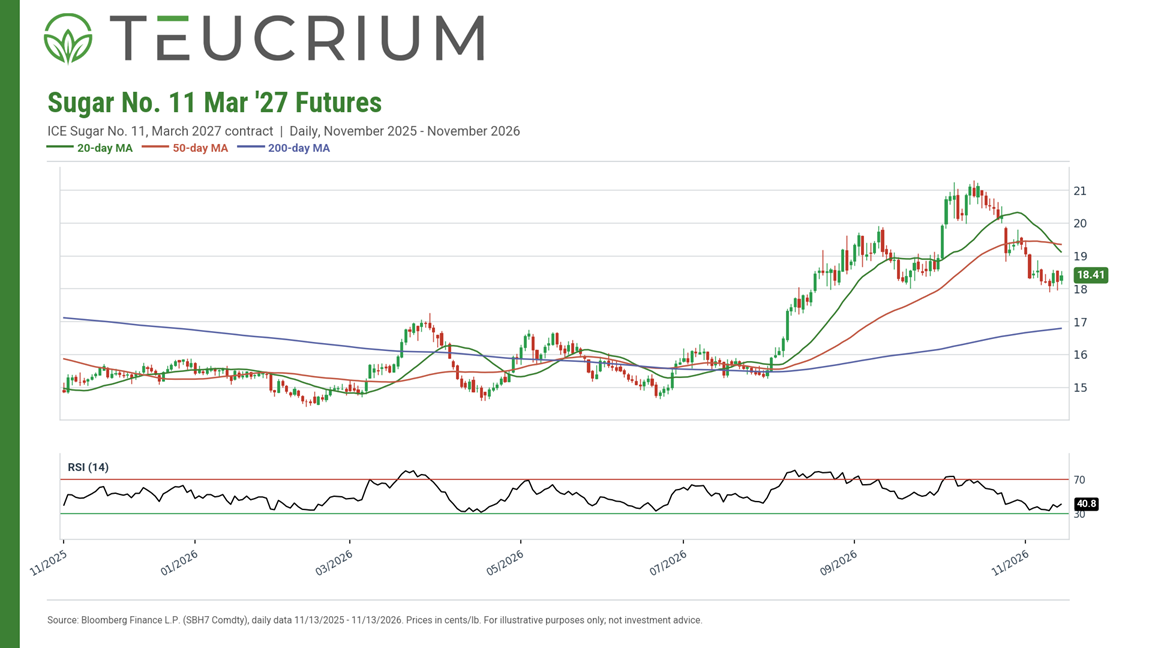
January soybeans settled at $12.31 1/2 a bushel on Friday, up 12 1/2 cents on the day and 37 3/4 cents, or 3.2%, on the week. That's the first weekly gain in 5 weeks and the highest settle since October 30. Most of it came Tuesday, when January rose 39 3/4 cents to $12.28, its largest one-day gain since July 6.
USDA published its November Crop Production report and its World Agricultural Supply and Demand Estimates (WASDE) on Tuesday. It raised the US soybean yield 0.2 bushel to a record 53.3 bushels an acre and production to 4.574 billion bushels. Both landed under the trade's average guesses. USDA also raised exports 25 million bushels to 1.72 billion, and that cut 2026/27 ending stocks to 300 million bushels from 315 million.
Pro Farmer, the farm advisory newsletter, had soybeans steady to a penny higher just before the report and 33 to 35 cents higher 20 minutes after it. Tim Bulfer, who writes Marex's midday notes, called the carryout the "only friendly number in beans" and said much of the buying came from funds in an oversold market, which triggered buy stops (standing orders to buy once price rises to a set level). "Feels like trade might have been shorter than they let on, given market reaction," he wrote. There's no fresh data yet to check how short funds were. Veterans Day pushed this week's Commitments of Traders report from the Commodity Futures Trading Commission (CFTC), the US futures regulator, to Monday, November 16, so the latest fund positioning data is as of November 3, 10 days ago.
USDA announced sales of 136,000 metric tons of soybeans to China on Thursday and 134,000 tons on Friday, alongside 150,000 tons to Mexico, 120,000 to Vietnam and 100,000 to unknown destinations. Weekly export sales of 42.4 million bushels were a 4-week low, though cumulative sales run 77.9% ahead of last year, per Mike Castle, who writes the daily Perspective note at StoneX, another commodity brokerage. China imported 7.35 million tons of soybeans in October, down from 9.48 million a year earlier and below analyst estimates of 9.5 million, per Charlie Sernatinger, who writes Marex's morning grain comments. On Friday Bulfer wrote that China was "said to have bought some 14 cargos of Brazilian new crop beans" overnight, and Sernatinger cited a report that China is holding arriving soybean vessels for as long as 20 days as its imports for the year near 100 million tons.
Watch for more Chinese purchases of US soybeans. "It was an impressive move yesterday, but it has not changed the trend yet," Sernatinger wrote Wednesday. More flash sales to China could help the rally continue, while a quiet week may leave January exposed to the selling that took it to $11.88 1/4 on Monday. President Trump and President Xi are slated to meet next week at the Asia-Pacific Economic Cooperation summit in Shenzhen, per Pro Farmer, and the US-China trade truce now runs to January 10. NOPA, the National Oilseed Processors Association (the US soybean crushers' trade group), reports October crush on Monday. Brazil's crop is 67% planted against a 63% average, per Conab, Brazil's national crop supply agency, and the forecast is wet for most Brazilian and Argentine grain areas over the next 10 days.
Corn
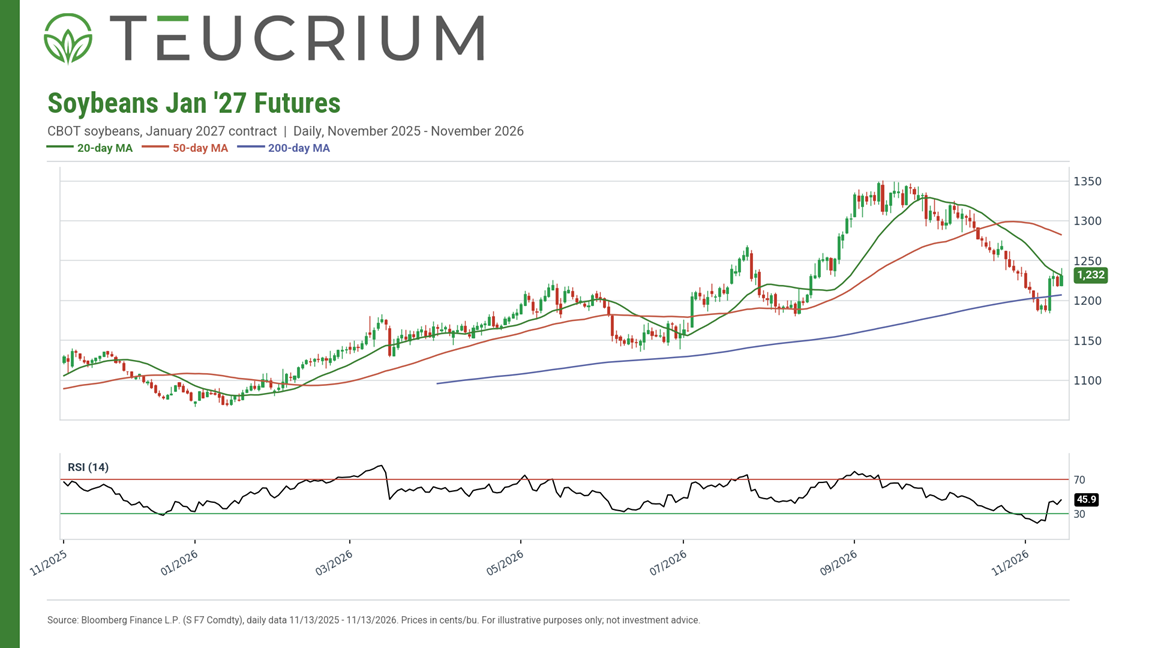
December corn settled at $4.45 1/2 a bushel on Friday, up 3 cents on the day and 4 cents, or 0.9%, on the week. That ends a run of 6 straight weekly losses.
USDA cut the US corn yield 1.6 bushels to 179.6 bushels an acre, below the 180.3 the trade expected, and cut production to 15.893 billion bushels from 16.034 billion. USDA also trimmed feed use and exports by 25 million bushels each, and ending stocks still dropped to 1.758 billion bushels from 1.849 billion. The trade expected 1.840 billion. Bulfer rated the report friendly for corn and added a caution: "many traders don't trust the USDA numbers anymore."
Export sales for the week ended November 5 were 113.4 million bushels, a marketing-year high and the largest for that week in records back to 1997/98, per Castle. Mexico bought about 726,000 metric tons more in 3 flash sales this week. Cumulative sales still trail last year by 27.8%. Harvest was 81% complete as of Sunday against an 86% average, the slowest since 2019 by Castle's count, and farmers aren't selling much of what they've cut. Sernatinger wrote Thursday that the week's farmer selling "was only enough to prevent any further increases in domestic basis levels; i.e. the job of getting the farmer to sell has not been done." (Basis is the local cash price relative to futures.) Pro Farmer's Hillari Mason cited University of Illinois budgets that put full-cost corn breakevens at $4.90 to $5.20 a bushel on northern and central Illinois land. "On many rented acres, corn is at or below the price needed to cover all costs," she wrote.
Watch farmer selling and the export pace from here. If farmers keep holding grain and Mexico keeps buying, prices may hold above Monday's low. Sernatinger noted that bears want USDA to cut its export estimate again in the December WASDE, so another slow week of shipments could add pressure. Monday's Crop Progress report should show harvest close to done.
Wheat
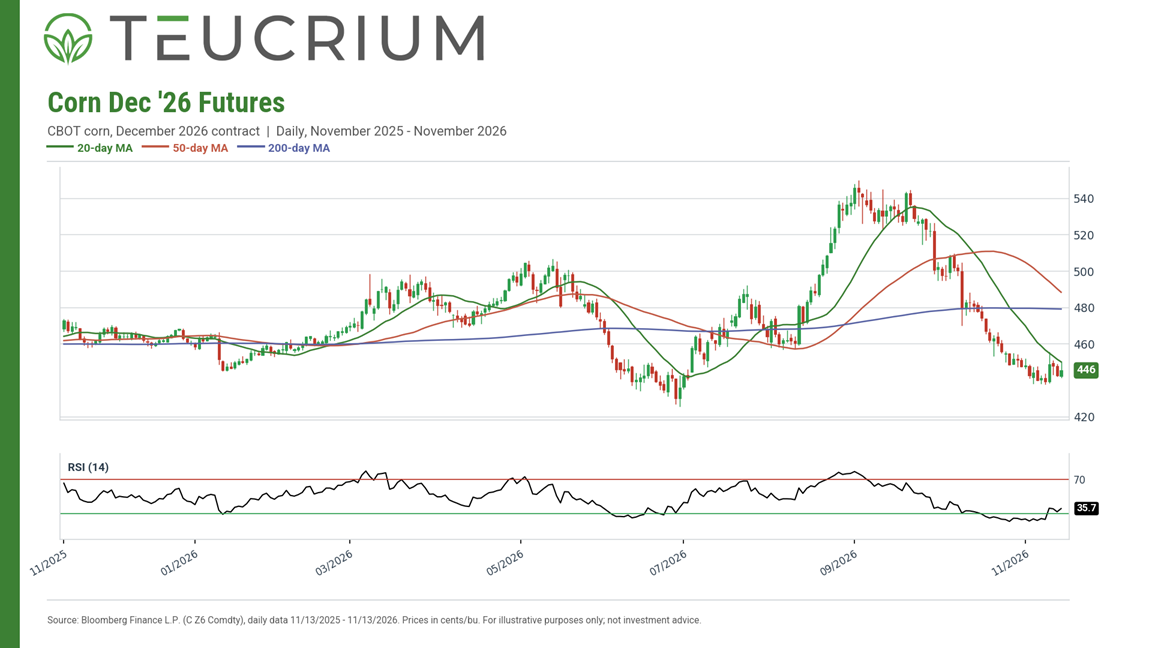
December Chicago wheat settled at $5.93 1/4 a bushel on Friday, up 9 cents on the day and 2 cents on the week, its first weekly gain after 10 straight losses.
Russia and Ukraine met in Abu Dhabi on Tuesday and Wednesday, with US envoys mediating. The talks produced a prisoner exchange and no agreement to reopen Black Sea grain shipping. Castle wrote Wednesday: "The wheat market has sold off aggressively over the last month-plus on headlines of 'progress' in this ongoing diplomatic push, but little has changed on the ground, or in Russia's maximalist demands." A drone strike hit Russia's Baltic port of Ust-Luga overnight Tuesday. Wheat jumped, then faded "as it became clear that the strikes hit energy, not grain targets," Castle wrote. US envoys Jared Kushner and Steve Witkoff met President Putin in Moscow on Thursday, and Sernatinger wrote that morning that the two sides "are nowhere near any grain corridor agreement."
USDA raised its estimate of 2026/27 world wheat ending stocks 4.78 million metric tons to 280.82 million, against a trade guess of 276.4 million. It added 1.5 million tons each to Argentina's crop (23.0 million) and Australia's (32.5 million). "There was nothing friendly in the wheat numbers," Bulfer wrote.
US export sales for the week ended November 5 were 6.7 million bushels, a marketing-year low, and cumulative sales trail last year by 29%, per Castle.
Marex's Friday morning note credited the day's gains to "short covering into the weekend, good exports, talk for dryness in Northern Brazil and no Black Sea peace deal." Bulfer tied Thursday's losses across the grains to US farmer selling and a stronger dollar. The dollar index traded above 103 this week for the first time since April 2025.
Watch whether Friday's short covering carries into next week. Russia and Ukraine agreed to widen the negotiations to include European representatives, per Castle, with no date set. A strike that stops grain loading could force shorts to buy, while more diplomacy headlines and larger Southern Hemisphere crops may keep rallies short.
Sugar
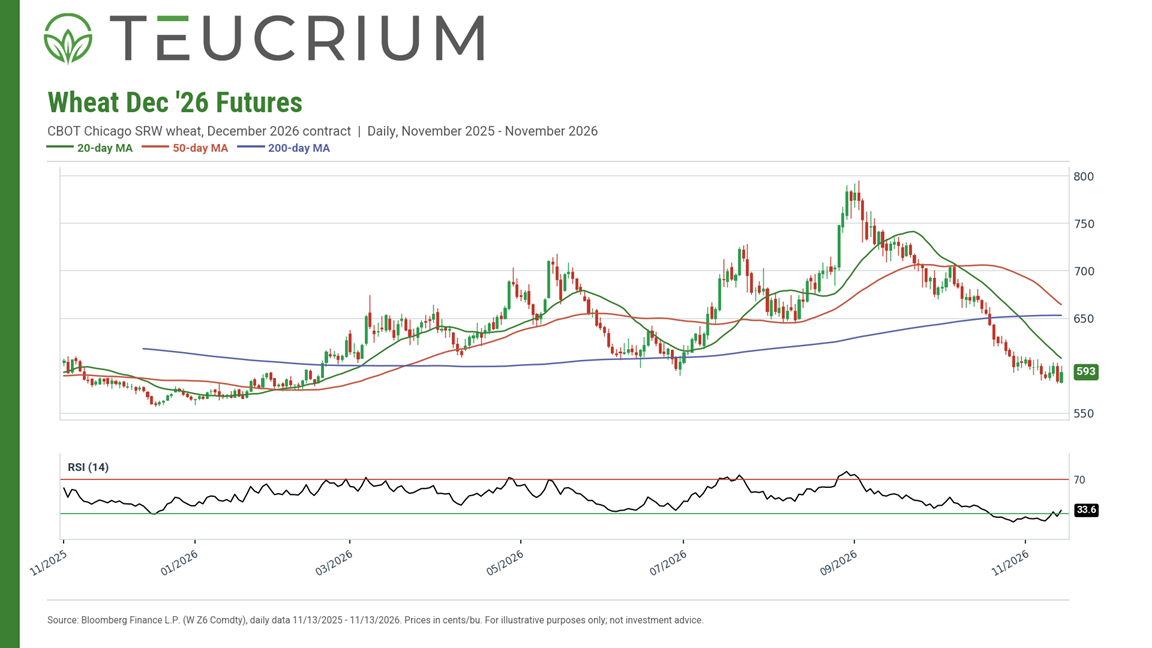
March raw sugar (ICE No. 11) settled at 18.41 cents a pound on Friday, up 0.19 cent on the day and 0.17 cent, or 0.9%, on the week. It's the first weekly gain in 4 weeks.
Brazil's real weakened to about 5.66 per dollar on Friday from 5.51 a week earlier, its weakest level since June 2025. A weaker real raises what Brazilian mills earn in local currency on dollar-priced sugar, which tends to encourage export selling. Barchart, the market data service, tied Thursday's 0.26-cent loss to the real and to India's output, and Wednesday's rally to short covering as crude oil rose. WTI crude oil settled at $88.56 a barrel on Friday, down 2.5% on the week, after trading as low as $83.88 on Tuesday.
The USDA office in Brasília cut its forecast for Brazil's 2026/27 sugar production 4% to 40.5 million metric tons and its export forecast 4.8% to 31.7 million, per Novacana, the Brazilian sugar and ethanol news service. Above-average rain in September and October delayed milling in the Center-South region, and analysts expect about 30 million tons of cane to be carried into the 2027/28 harvest. Brazil's agriculture ministry reported Center-South sugar output of 2.08 million tons for the second half of October, down 0.7% from a year earlier, on a cane crush up 3.6%, per Reuters. Ethanol output fell 13.3%. São Martinho, one of Brazil's larger sugar and ethanol producers, said it plans to send 53% of its cane to ethanol this season after its sugar revenue fell 37.5% in the September quarter.
India's mills produced 1.29 million tons from October 1 to November 5, against 320,000 tons a year earlier, per ISMA, the Indian Sugar & Bio-Energy Manufacturers Association, the mills' trade group.
Further weakness in the real could keep pressure on March sugar, while a harvest that runs into December on wet fields may shift more supply into next season. India's duty-free window for raw sugar imports closes December 31.