


See how money managers are positioned. Check out our CFTC Managed Money Monitor here: https://teucrium.com/cftc_managed_money_monitor
Soybeans
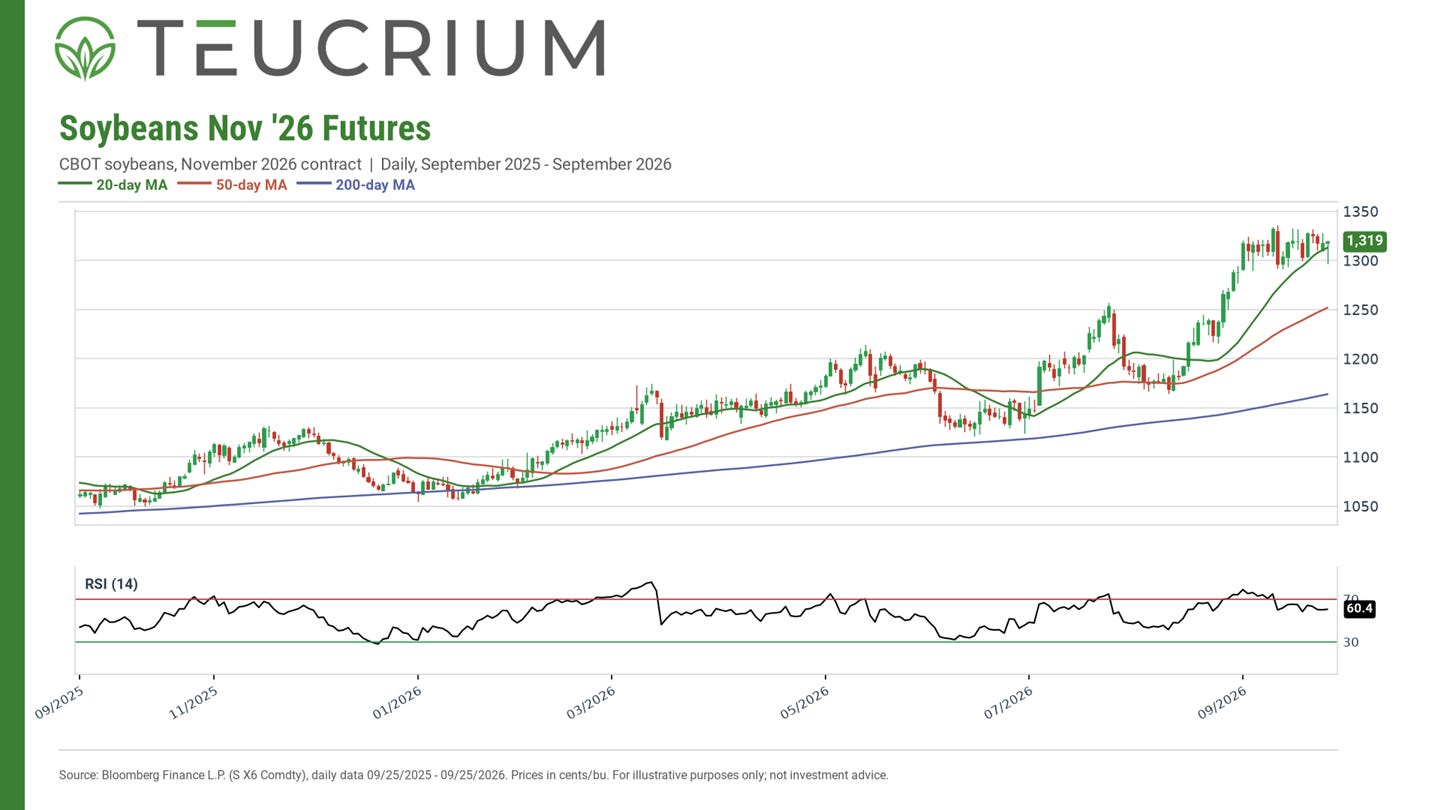
November soybeans settled at $13.19 Friday, up 1 1/2 cents on the day and 15 1/2 cents on the week, the best weekly gain among the grains. Price dropped to $12.97 1/2 Friday after the Trump-Xi summit ended without an ag deal, then climbed 21 1/2 cents off the low to finish near the day’s high. December meal added $12.40 on the week to $371.00 after a contract-high $372.40 settle Thursday, while December bean oil lost 38 points to 67.84 cents.
Meal carried beans again this week as too much rain slowed harvest in key locations. Pro Farmer’s Thursday note had “short-bought domestic processors” scrambling for supply with western Corn Belt fields too wet to harvest, and Marex’s Wednesday comment reported a couple of western crushers already running out of beans.
Iowa had 2% of its soybeans out against a 5% average, per Standard Grain’s Joe Vaclavik, even with the national harvest ahead of pace at 12%. Funds piled in: managed money held a record net long of 265,159 contracts as of Tuesday, September 22 (CFTC, futures only), up 23,658 on the week and above the 257,258 set on September 8.
Export demand, however, didn’t match the trader’s enthusiasm. Sales for the week ending September 17 were 582,400 metric tons, the third lowest for that week in 30 years. Still, cumulative sales are running nearly double last year.
China bought a 120,000-ton flash sale Thursday. The summit delivered a 2-month extension of the tariff truce to January 10, but not much else by Friday’s close. Charlie, who writes Marex’s morning comment, summed it up Friday: “it looks like we feasted on pageantry, and famined on substance with the meetings.” Trade Representative Jamieson Greer told CNBC the two sides agreed on a “subset” of non-sensitive goods, with details promised Monday.
Monday’s details are the first input. Castle pointed out that the last two summits, in October 2025 and May 2026, were each followed by a weekend White House fact sheet that revived speculative buying; a tariff cut on US beans could support prices, while an empty readout with a record fund long in place may invite liquidation.
The September 30 Quarterly Stocks report comes out next week with the trade looking for 324 million bushels against 325 million a year ago. StoneX’s Matt Zeller noted the report has produced bearish soybean moves in each of the last five years. Watch the western harvest too: if fields dry out, the basis and meal premium that carried the week could fade quickly.
Wheat
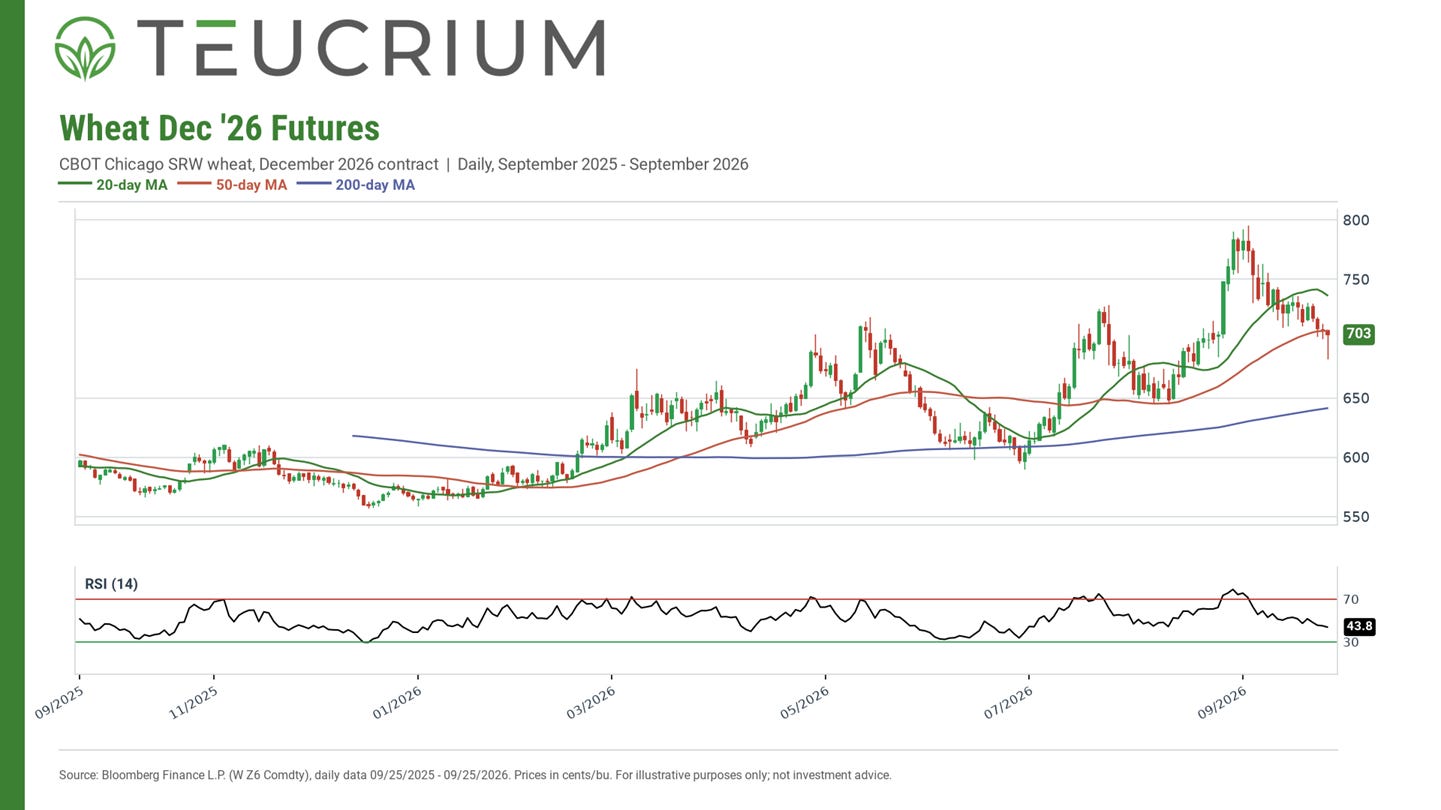
December Chicago wheat settled at $7.03 1/4 Friday, down 3 3/4 cents on the day and 11 cents on the week, its fourth straight weekly decline and its lowest settle since August 25. Kansas City fell 21 3/4 cents on the week to $7.62, and December spring wheat lost 27 3/4 cents, about 3.7%, to $7.13 1/2, the biggest weekly drop in the complex. Chicago is now 80 3/4 cents, roughly 10%, below the $7.84 contract-high close of August 28.
Some Russian wheat moved, and the market read it as bearish sign. Marex’s Monday comment had Russia shipping 75,000 metric tons out of the Black Sea, up from 7,400 the week before. Castle reported Turkey pushing to revive the Black Sea Grain Initiative with backing from India, Egypt and Middle East buyers; Ukraine is reportedly willing to participate leaving Russia as “the biggest unanswered variable.”
The collapse in Russian exports is ongoing (Kpler, via Vaclavik, sees Russia’s September exports near 1 million tons against 5 million a year ago), but buyers are routing around it: Egypt to France, Indonesia to Argentina and Australia. Unfortunately, US wheat isn’t getting that business. Export sales were 267,600 tons for the week ending September 17, which Marex graded “very poor,” and cumulative sales are 31% behind last year, the slowest in three years.
Funds pressed the short side of the trade: managed money was net short 12,016 Chicago contracts as of September 22 (CFTC, futures only), 8,342 more than a week earlier, while KC’s net long slipped 3,778 to 40,635 and spring wheat held 21,397.
At home, Plains rain arrived for seeding. Winter wheat was 17% planted against a 21% average, which Castle called the slowest start on record for the week, but he expects the wet 10-day forecast and “lofty crop insurance prices” to lift planted acres.
The September 30 Small Grains Summary comes first, with the trade expecting all-wheat production of 1.524 billion bushels against 1.531 billion and Zeller calling for “yet another minor reduction.”
Pro Farmer labeled Friday’s closes “technically bearish weekly low closes,” and Marex’s Tim Bulfer warned Wednesday that if fund length liquidates through chart support, “prices could see some big breaks.”
Anything concrete on a Black Sea corridor could pressure prices further. Watch for the talks stalling, though; with funds short and the physical flow still a fraction of normal, a failed-corridor headline may move prices up faster than the fundamentals alone would suggest.
Corn
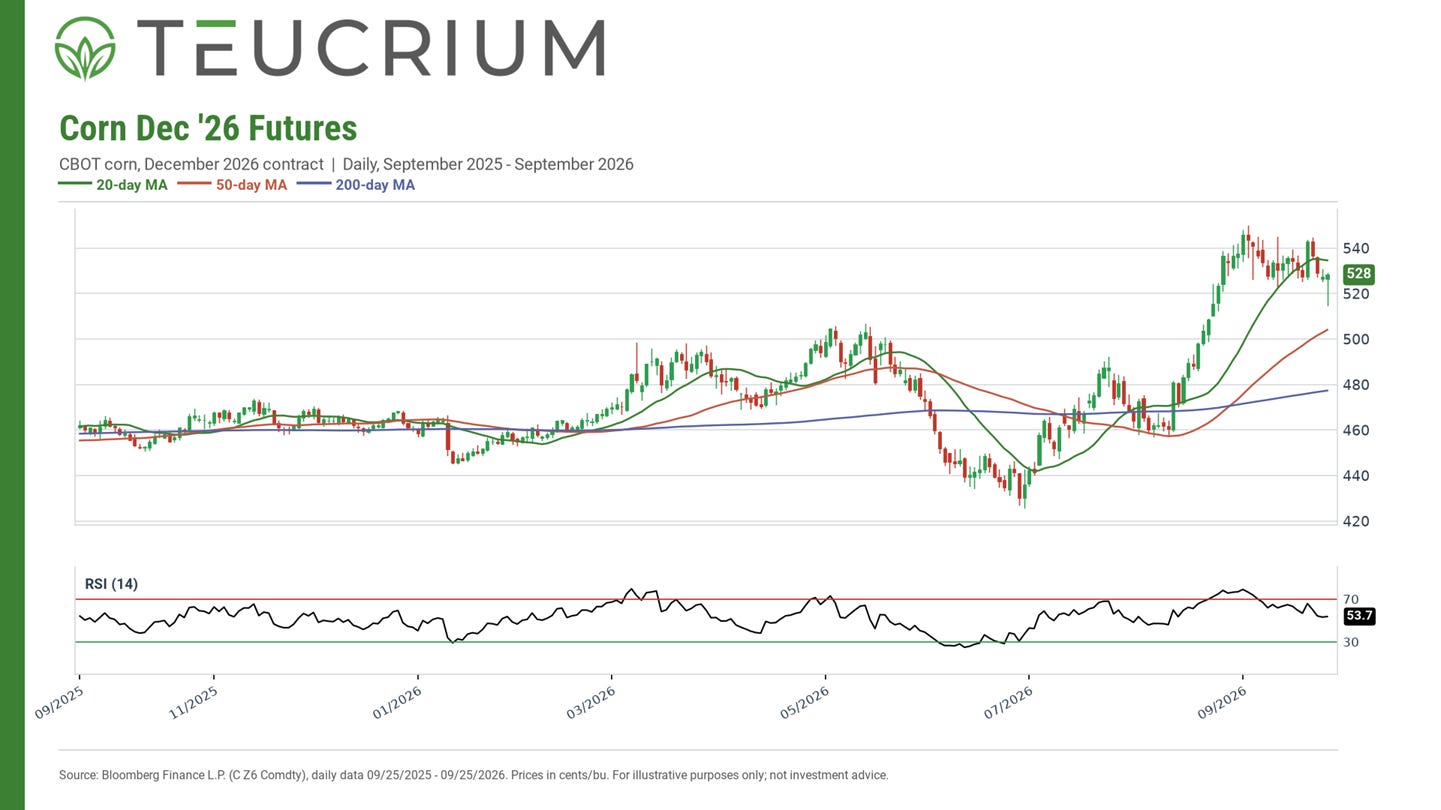
December corn settled at $5.28 1/4 Friday, up 3/4 cent on the day and 3/4 cent on the week, a flat finish that hid a 29 3/4-cent range. Monday rallied 15 1/2 cents to $5.43 on China hopes and weekend rain, and Friday’s early trade broke to $5.14 3/4, a four-week low, before corn recovered the whole move. Pro Farmer’s Friday morning note had already called it “a downside breakout from its trading range.”
The funds finally blinked. Managed money cut its net long by 10,363 contracts to 404,097 as of September 22 (CFTC, futures only), the first real reduction from the 414,460 record, and it came before Thursday’s summit let the air out. Relatively slow export demand gave the trade little reason to stay long.
Export sales for the week ending September 17 were 838,300 metric tons, which Marex called “poor,” and cumulative sales are 29% behind last year even though inspections hit a five-week high. Castle read the gap as a price problem: “that slow pace of sales is more likely a reflection of buyers remaining on the sidelines amid the spike in price.”
Ethanol output fell 6.5% to 1.028 million barrels a day, a 20-week low, with stocks at a record for the week, which takes some shine off California’s E15 signing Monday. Vaclavik notes that California’s E15 policy could potentially lead to about 650 million gallons of additional demand.
Some market participants were hopeful that there would be an announcement from the Xi summit that would be buying U.S. corn. No announcement was made.
Bulfer said it plainly Tuesday: “It does not pay or make sense for China to buy US corn and wheat, but funds expect China to buy corn and wheat for political reasons.” Costs are the other story.
Diesel hit a record $6.53 a gallon nationally and $6.68 in the Midwest, and Castle’s line was that “farmers are not going to leave their crops in the field to rot just because fuel prices are too high. Effectively, that just translates into margin pressure.” Harvest reached 13% against an 11% average, with Iowa at 4% against 5%.
The September 30 stocks report sets the old-crop carry-in. The trade expects September 1 stocks of 1.918 billion bushels against 1.551 billion a year ago, with a trim to 2025 production to 17.003 billion from 17.021 billion. A bigger cut could tighten the balance sheet and support prices.
Harvest hedging is the counterweight, and Pro Farmer flagged that commercial pressure “could push prices farther south in the near term.” Still, Friday’s recovery from the four-week low may mark near-term support. Watch for whether funds keep trimming a 404,000-contract long into full harvest; if they do, rallies would likely meet selling ahead of the October 9 WASDE.
Sugar
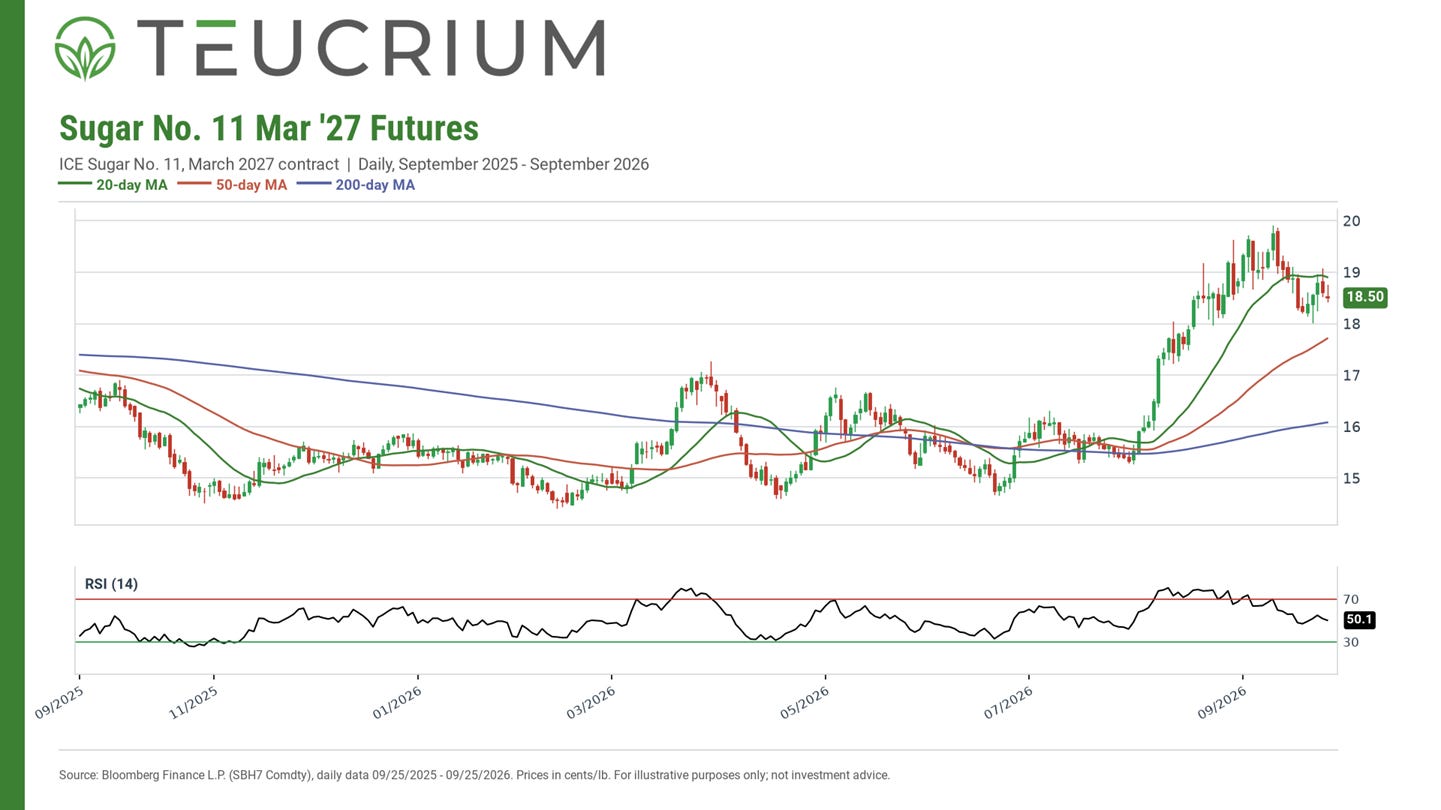
March raw sugar settled at 18.50 cents Friday, down 11 points on the day but up 26 points, about 1.4%, on the week. October, which expires September 30, settled at 17.50, up 14 points on the week, and the March-October spread sits at a full cent. March is still about 6% below its September 10 close of 19.75.
Brazil’s rain stayed the story, and it cut both ways. A Platts survey of 10 analysts, relayed in Expana’s Friday media digest, put first-half September Center-South sugar output at 2.09 million metric tons, down 42.5% from a year ago, with crush down 35.4% to 29.8 million tons and cane quality at 147.53 kilograms per ton against 154.59. That quality measure, total recoverable sugar (ATR, from the Portuguese açúcar total recuperável), is the amount of sugar mills can extract from each ton of cane, so a lower reading means less sugar from the same crush.
Hedgepoint cut its 2026/27 Center-South sugar forecast by 1.4 million tons to 38.5 million and its sugar mix to 46.8%. StoneX cut its 2025/26 global surplus to 1.45 million tons from 2.9 million because of the crushing delay. It also shrank its 2026/27 deficit to 900,000 tons from 1.7 million, since cane left in the field isn’t lost, just crushed later. StoneX sees 22 million tons carried into the 2027/28 season, which would help lift the future year’s crush to a record 662.1 million tons.
News from India added price support. The Western Indian Sugar Mills Association expects Maharashtra output to fall about 20% to roughly 8 million tons, and the digest reported India is likely to import for a second straight year.
Macro economic conditions presented headwinds this week. The dollar index rose 0.8% to 100.97, the real weakened about 0.8% to 5.18 per dollar, and WTI fell 3.8% to $92.41, which cools the ethanol pull on cane (Bloomberg). Sugar rose anyway. Managed money cut its net long by 8,801 contracts to 216,629 as of September 22 (CFTC, futures only), the second straight weekly reduction from the September 8 peak of 238,684.
The October expiry on September 30 is the next read on physical demand. Hedgepoint flagged that some price correction may occur if Brazil recovers ATR and sugar mix over the next two weeks, provided India doesn’t approve more import quotas. Lower crude could tilt mills back toward sugar, which would likely be read as bearish; a crude rebound on the Hormuz talks stalling could do the opposite. Watch for UNICA’s return, too. It still hasn’t published crush data past the end of June, and real numbers may settle a market trading on estimates.
Topics:
