Wheat
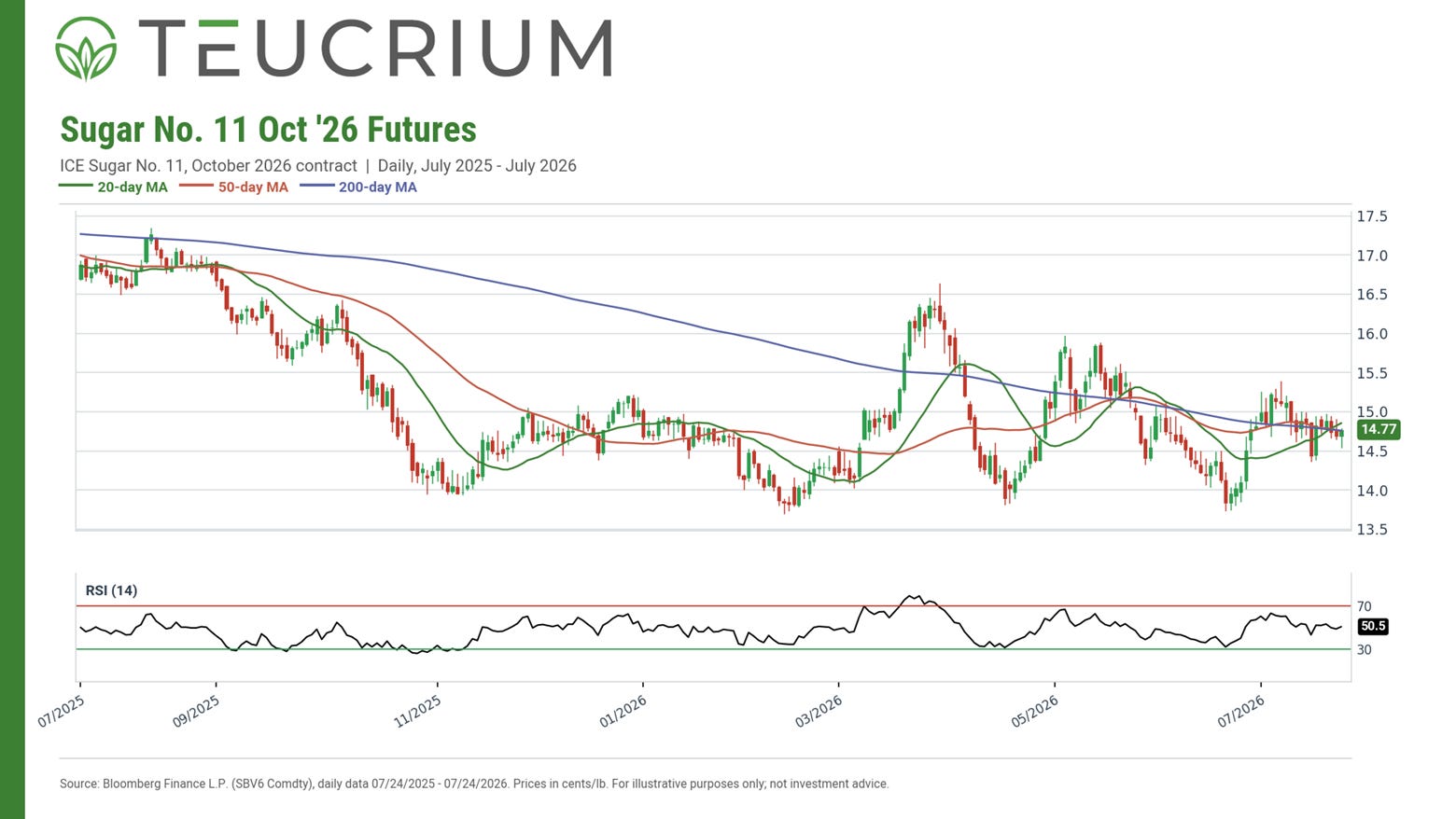
September Chicago wheat settled at $6.78 Friday, down 18 1/4 cents on the day after printing a contract high of $7.11 1/4 overnight. That capped a wild ride: Wednesday’s 27 3/4-cent surge to a $7.05 3/4 contract-high close had the market leading the whole grain complex, and by Friday’s bell it had given the week back, settling 4 3/4 cents below the prior Friday. The hard wheats held on better: September Kansas City finished the week up 13 cents at $7.45 1/4 and September spring wheat added 22 1/2 cents to $7.14 1/4.
Russia pounded Odesa port infrastructure and shut off Sea of Azov access, a route that normally moves about a quarter of Russian grain exports, while Novorossiysk, the largest Russian grain port at up to a third of shipments, went to a midnight-to-5 a.m. navigation ban after near-daily Ukrainian drone attacks.
Meanwhile, shipowners suspended arrivals at Ukraine’s ports on their own initiative.
Reuters reported traders see 4 to 6 million tons of wheat shipments potentially delayed.
Underneath the headlines sits a real supply story: Sovecon cut Russia’s 2026 crop to 88.3 million tons from 91.4 million last year, analysts trimmed Russia’s July exports 25% to 1.5 million tons, EU grain production is tracking more than 9% below last year with Paris wheat up about 20% on the month, and the North Dakota tour wrapped with a 48 bushel spring wheat estimate against USDA’s 58 for the state, on the smallest planted area since 1969.
Funds noticed too, cutting SRW net shorts from 79,407 contracts in early June to 36,798 by mid-July, with Marex flagging gamma buying off the $7 strike and implied vol back at 45%. Then Friday brought talk of a reopening compromise, wheat broke hard, and Ukraine’s ag minister denied official talks were even underway. StoneX’s Mike Castle called it “geopolitical headline whiplash,” and Arlan Suderman added the structural caveat: “the U.S. is at the end of the line for meeting global wheat demand.”
Watch for whether any corridor mechanism actually materializes. If the ports stay effectively shut, wheat could retest its highs, and the North Dakota shortfall gives that case something physical to stand on rather than pure headline risk. A workable deal could pull the war premium out just as fast as it went in, and Pro Farmer read Friday’s action in the winter wheats as “key reversals” down, which it called “early technical clues of near-term market tops being in place.” Its broader caution fits the tape: “funds can shift positioning on a dime.”
Soybeans
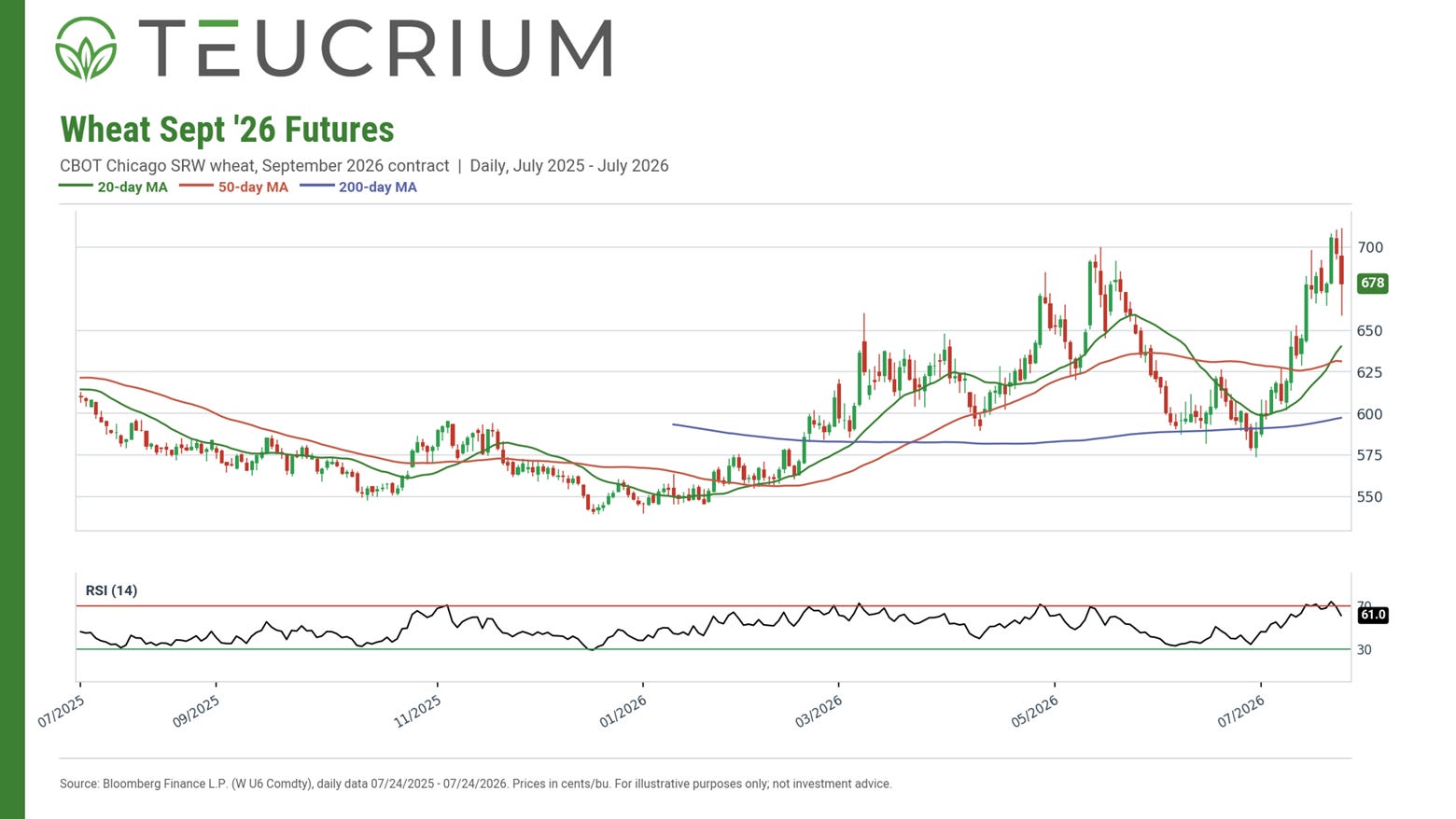
November soybeans settled at $12.53 1/2 Friday, up 9 3/4 cents and a fresh contract high, the only row crop to close the final session higher. Beans added just over 50 cents on the week, about 4%, and have now taken out the contract high set back in late 2022.
USDA flashed new-crop sales all week: 264,000 tons to China Monday plus 110,000 tons to unknown destinations the same day, another 126,000 tons unknown Thursday, on top of 340,000 tons to China and 256,634 tons to Mexico the previous Friday. Thursday’s weekly report showed 1.537 million tons of new-crop bean sales, more than the trade expected, though old-crop business was thin at 56,400 tons and accumulated sales still run 18% behind last year.
Suderman pegs Chinese new-crop purchases at 160 million bushels against Beijing’s 919 million bushel commitment, and he is careful about the headline number: the 225 million bushels of new-crop sales on the books is “the highest in four years for mid-July, but unimpressive overall.” He reads the buying partly as trade politics, with China purchasing “as a means to get concessions” on bigger disputes. Standard Grain’s Joe Vaclavik is blunter about what’s driving it: the rally is “mainly attributed to Chinese purchases,” with US weather “likely a secondary issue.” Late-July heat in the western belt and Thursday’s 6.2% crude jump didn’t hurt, and Marex looked for funds to have bought 26,000 lots of beans into Friday’s COT report.
Pro Farmer’s seasonal math is worth noting: the average summer-rally gain projects to roughly $12.61, so this move may be closer to its end than its start. Watch the pace of Chinese purchases and the August heat maps. Continued heat could keep the bid under the market, while a settle back below $12.22 3/4 might signal the summer rally has run its course.
Corn
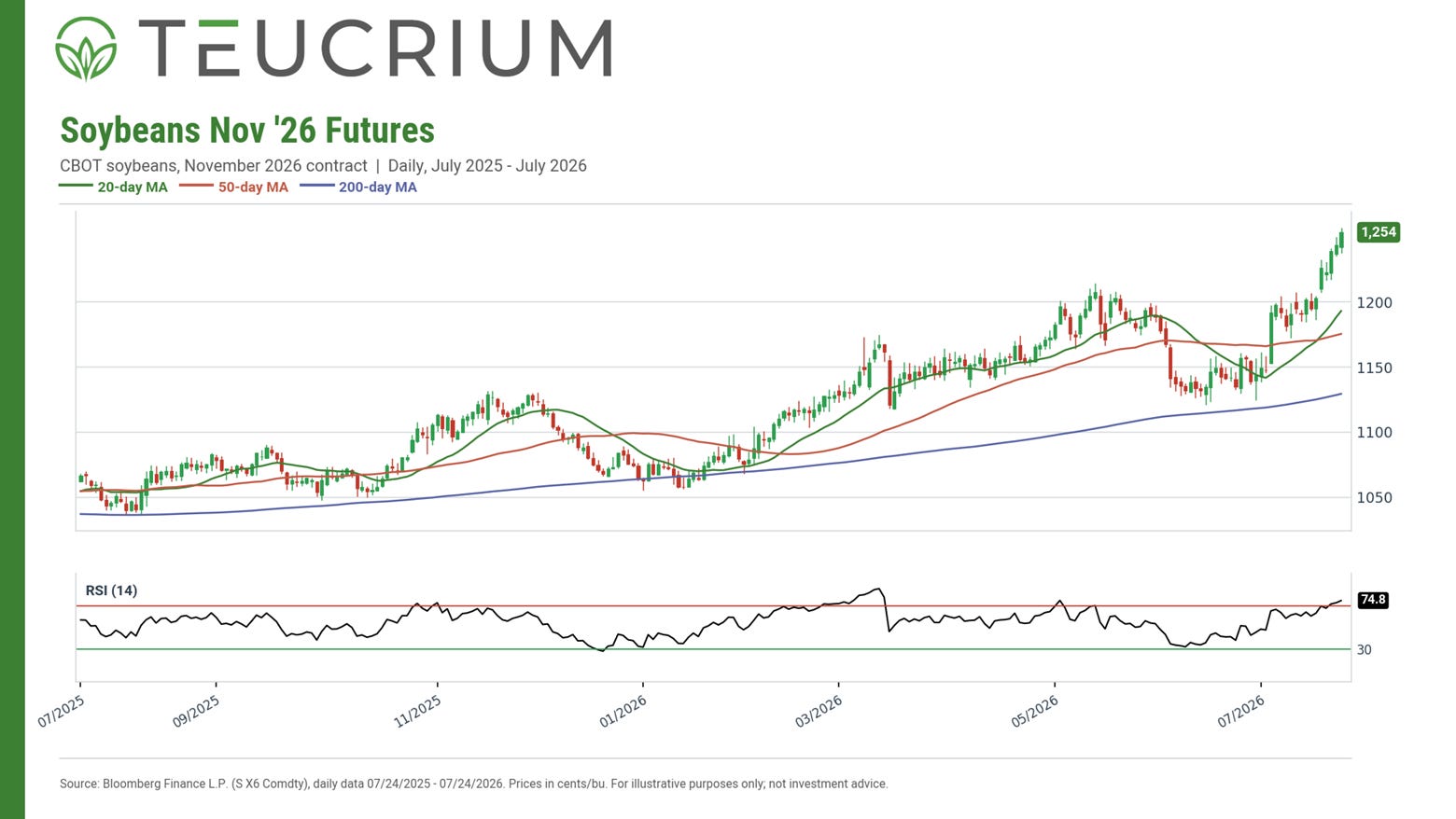
December corn settled unchanged Friday at $4.87 1/2 after touching $4.92, a two-month high, earlier in the session. The week added 20 cents, about 4%, with gains stacking every day from Monday through Thursday.
A heat wave that sat over the Plains for more than a week spread into the western Corn Belt, and USDA trimmed good/excellent ratings a point to 67%, still a point better than the trade guessed. The yield spread is the tell: crop consultant Michael Cordonnier cut his estimate to 181 bushels per acre, Suderman’s model sits at 186.7, AEI is at 188.96 and CropProphet at 187.7, all against USDA’s 183 trend figure.
Nearly every private model runs above USDA, which tells you how much of this rally is weather premium rather than confirmed crop loss.
Energy pitched in hard. WTI settled Thursday at $92.19, up 6.2% and its highest close since early June after Houthi attacks on two Saudi oil tankers in the Red Sea, and ethanol production hit 1.094 million barrels a day with Corn Belt margins running 10 to 35 cents positive. Crude gave a chunk of that back Friday, which is part of why the grains stalled into the weekend.
Demand isn’t uniformly strong, either. Weekly export sales came in at 332,700 tons, below expectations for a second straight week and 44% under the prior four-week average, even with accumulated shipments 25% ahead of last year. FranceAgriMer rated France’s corn crop 38% good/excellent, the worst in its records, and EU corn production is headed for a 19-year low, which could open European demand for US corn if Black Sea logistics stay snarled. Marex put the positioning plainly: “The money wants back in on the longside.”
Monday’s crop ratings and the August heat maps are the swing inputs. Forecast heat building into August could keep support under prices, while a cooler shift might invite the profit-taking Pro Farmer warned about: summer weather rallies “can pop up fast and can die just as quickly.” Trade policy is the other wildcard, with a 50% tariff on select Canadian imports due August 19 and USMCA left unrenewed while Mexico sits as the top buyer of US corn. Caution also makes sense ahead of the August WASDE.
Sugar
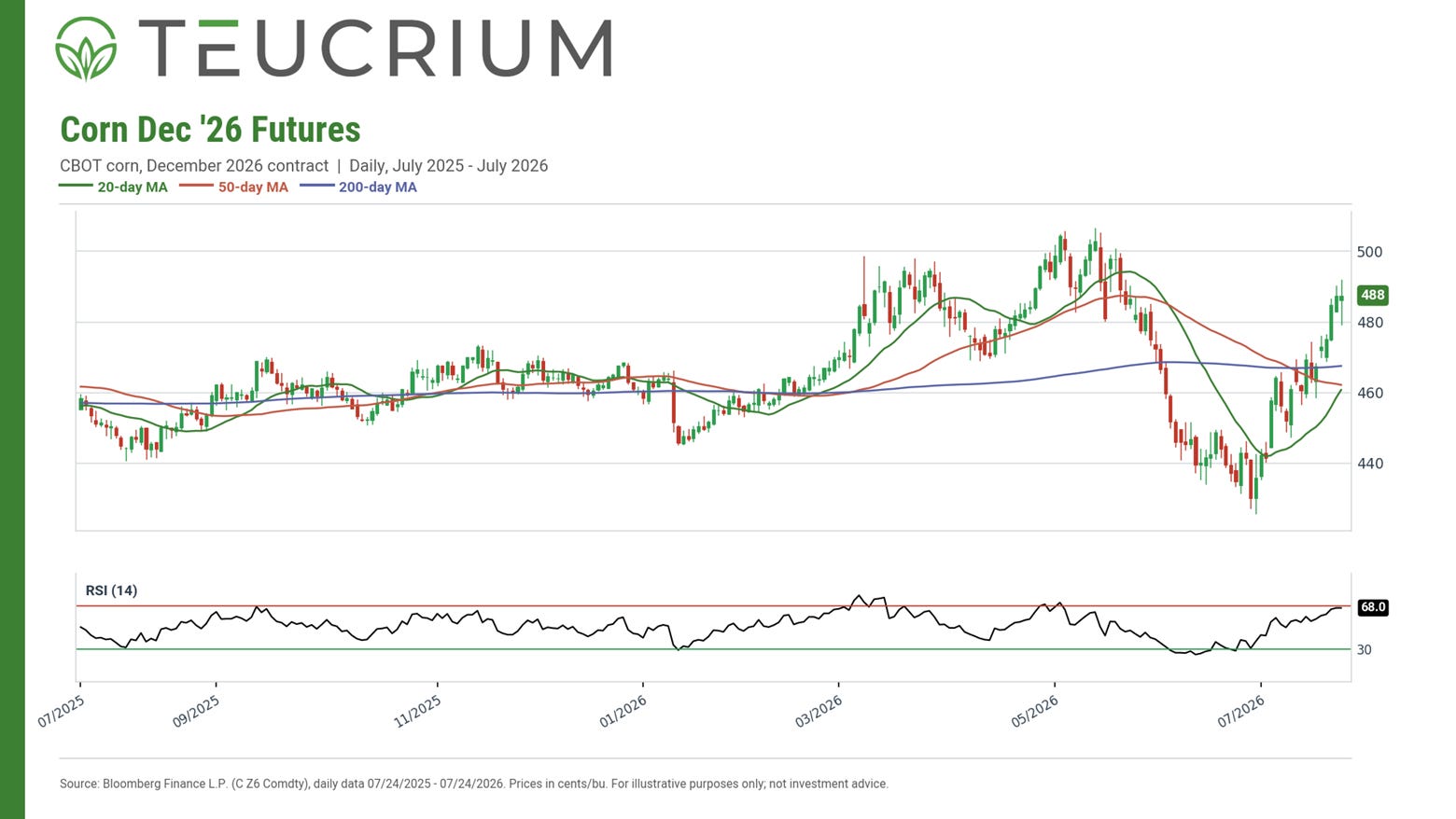
October No. 11 sugar settled at 14.77 cents per pound Friday, up 0.08 on the day, still parked in the middle of the range it has held since spring. The futures tape was quiet; the loudest sugar news came from the physical and policy side.
Domestic prices in India hit records, with ex-mill Uttar Pradesh at 4,400 to 4,500 rupees a quintal, up roughly 300 in a month, and New Delhi is weighing stock limits after a weak monsoon hurt cane; Karnataka growers are asking for a drought declaration across more than 180 taluks. ISMA has trimmed this season’s output estimate to 32 million tons, though USDA’s local office sees next season rebounding about 12% to 33.6 million..
In Brazil, federal prosecutors moved to suspend the newly approved 32% ethanol blend, one of three legal challenges now pending, and where that lands could shape how much cane goes to ethanol versus sugar next season. Thursday’s crude spike to $92.19 sharpens that math, since stronger energy prices pull Brazilian mills toward ethanol and away from sugar, though crude gave some of the move back Friday.
Washington, meanwhile, set FY2027 raw sugar import quotas at the WTO minimum of 1.12 million tons, cutting Brazil’s allocation from 156,000 to 100,000 tons while the Philippines held 145,000 and climbed to the number 2 slot.
Watch whether India actually imposes stock limits or shifts export policy, how Brazilian courts treat E32, and whether crude holds its gains. Tighter Indian supply could support world prices, while a blend mandate stuck in court might push more Brazilian cane toward sugar and cap rallies.