



September’s second survey-based corn yield landed at 178.5 bushels per acre, down 2.2 from August but four tenths above the average analyst guess. Production fell 213 million bushels. Then USDA cut feed and residual use 150 million, so new-crop carryout only dropped 86 million to 1,567 million, 56 above the 1,511 million the Bloomberg survey wanted.
Soybeans added production and tightened anyway.
The U.S. wheat balance sheet didn’t move at all. Price forecasts moved instead: corn up $0.30 to $4.80, soybeans up $0.60 to $12.00, wheat up $0.20 to $6.40.
We remain in Golden Grain Cycle Stage #1, with prices near cost of production, and U.S. new-crop corn stocks-to-use just broke below 10%.
CORN
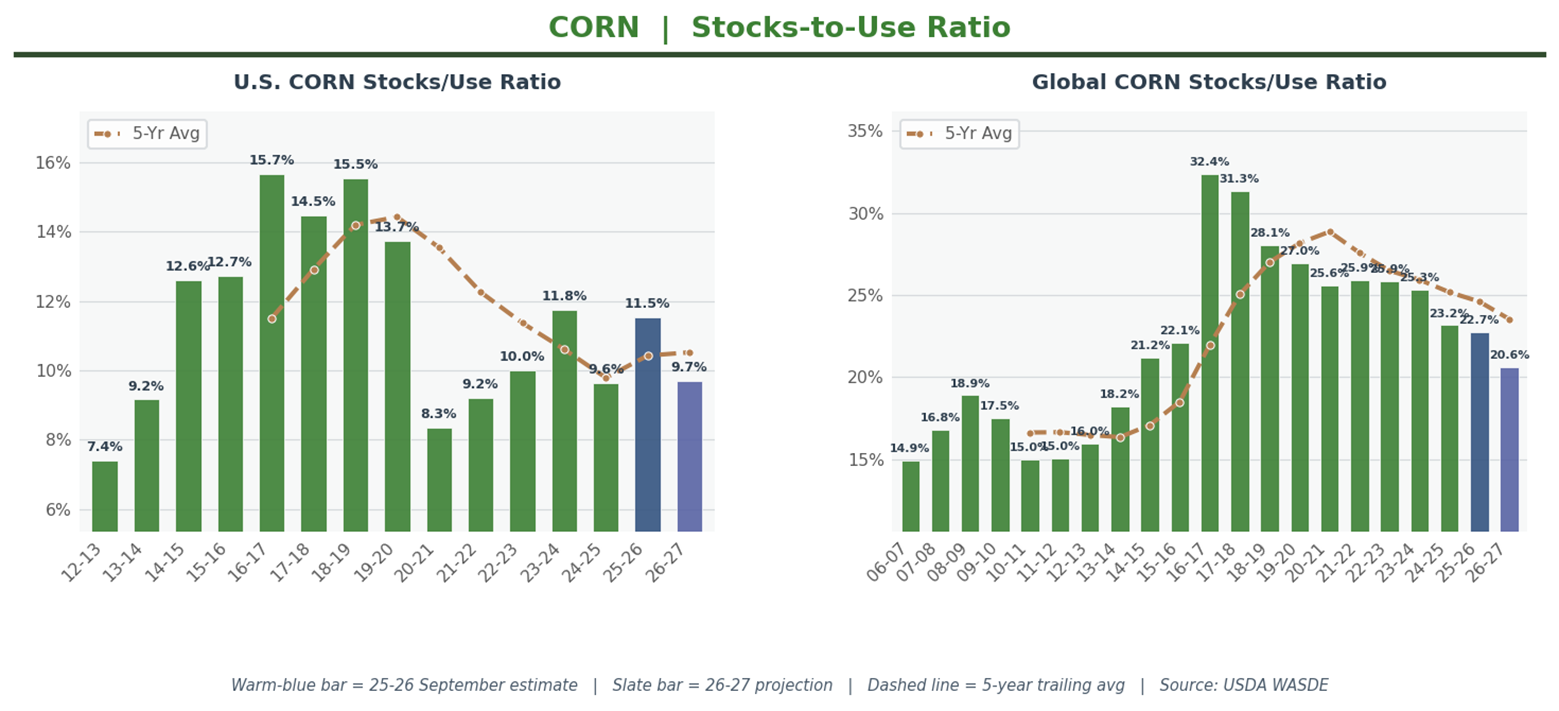
NASS’s second survey-based yield came in at 178.5 bushels per acre, 2.2 below August and a shade above the 178.1 analysts averaged. Harvested area slipped a tenth to 88.5 million acres. Production fell 213 million bushels to 15,800 million, which would still be the second-largest U.S. corn crop on record behind last year’s 17,021 million.
USDA cut 2026/27 feed and residual use 150 million bushels to 5,950 million and left exports alone at 3,275 million, citing steady demand despite the smaller crop. Total use fell 150 million to 16,180 million. Ending stocks dropped 86 million to 1,567 million, 56 above the analyst average and well inside the survey range of 1,359 to 1,630. New-crop stocks-to-use falls to 9.7% from 10.1%, the first sub-10% reading of this cycle.
USDA raised the 2026/27 season-average corn price $0.30 to $4.80 per bushel, a bigger move than the balance sheet alone would suggest.
Old crop tightened quietly. USDA raised 2025/26 exports 25 million bushels to 3,425 million, pulling ending stocks down 23 million to 1,922 million against a 1,938 million analyst average. The 2025/26 season-average price held at $4.15. Old-crop stocks-to-use now sits at 11.5%, down from 11.7%.
World 2026/27 ending stocks fell 2.6 million tons to 272.10 million, landing almost exactly on the 272.1 survey average. Production dropped 7.9 million tons to 1,290.95 million on cuts for India, Kenya, and Russia, partly offset by the EU. India lost both area and yield to below-normal rainfall, and a prolonged dry spell caused widespread crop failure in Kenya’s grain basket. Brazil’s export forecast came down on a higher domestic ethanol grind. World new-crop stocks-to-use eases to 20.6% from 20.8%.
SOYBEANS
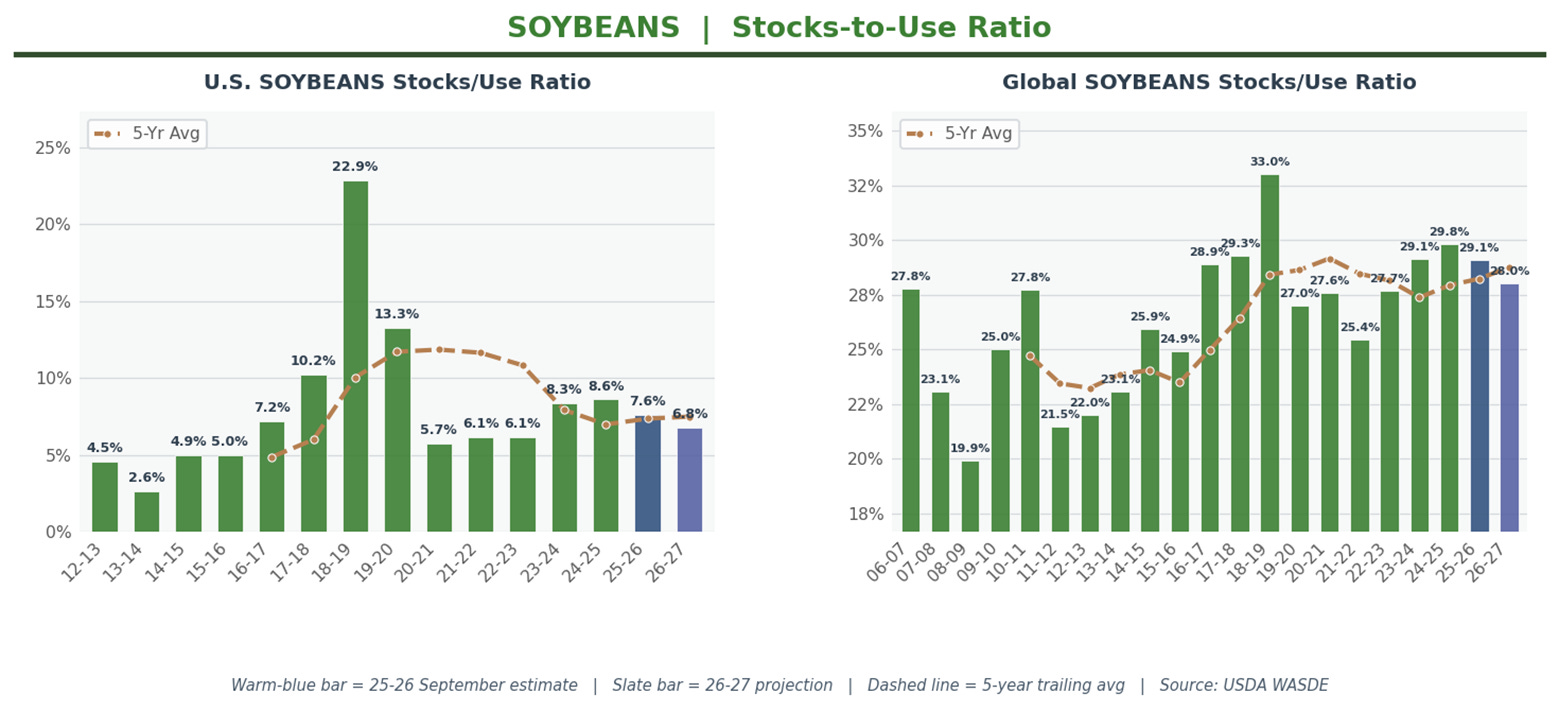
Soybeans production was revised higher, but ending stocks moved lower on strong demand.
Yield rose a tenth to 52.8 bushels per acre and harvested area rose a tenth to 85.9 million, putting production at 4,535 million bushels, up 16 million and 43 above what analysts expected.
USDA raised 2026/27 soybean exports 25 million bushels to 1,685 million and held crush at a record 2,780 million. Ending stocks fell 10 million to 310 million, though that’s still 19 above the 291 million analyst average, which had leaned a good deal tighter. New-crop stocks-to-use drops to 6.8% from 7.0%.
The 2026/27 season-average soybean price forecast rose $0.60 to $12.00 per bushel and meal rose $30 to $340 per short ton. Oil held at 70 cents per pound.
Old crop didn’t move. The 2025/26 ending stocks estimate stayed at 325 million bushels, 5 above the analyst average, and stocks-to-use holds at 7.6%. The 2025/26 season-average price ticked up a dime to $10.50.
Globally, 2026/27 ending stocks slipped 0.2 million tons to 124.02 million, mostly on lower U.S. stocks. World production edged up to 442.35 million tons on gains for the United States and Canada against cuts for India and the EU, and world crush rose to 385.22 million. World new-crop stocks-to-use eases to 28.0%.
WHEAT
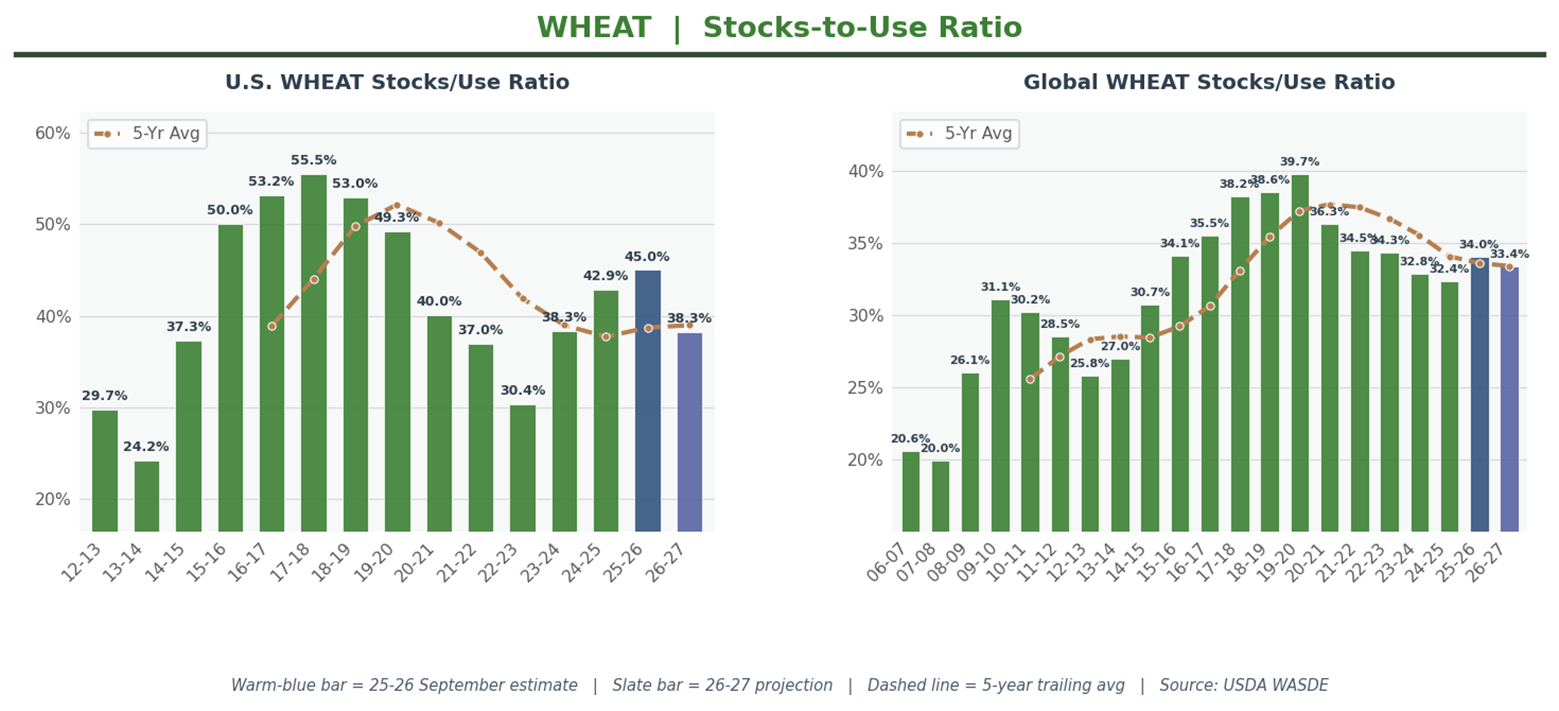
Every aggregate U.S. supply and use category held flat. The only U.S. change sat inside exports, where white wheat picked up 20 million bushels and Hard Red Winter and Hard Red Spring gave back 15 and 5 million on reported sales and shipments to date and prices against key competitors. Ending stocks stay at 717 million bushels, right where analysts had them at 718. U.S. stocks-to-use holds at 38.3%, down from the just-ended year’s 45.0%.
USDA lifted the 2026/27 season-average farm price $0.20 to $6.40 per bushel. Three reasons were cited: NASS prices to date, expectations for futures and cash over the balance of the marketing year, and, in USDA’s own words, higher U.S. corn prices. Wheat, in other words, is getting paid for corn’s problem.
The world balance sheet loosened. Global supplies rose 3.5 million tons to 1,103.0 million on bigger crops in the exporting countries: Australia up 3.0 million tons to 31.0 million on abundant rain in South Australia and Victoria, Canada up 1.0 million to 36.0 million, and Ukraine up 0.6 million to 26.0 million on a record yield as harvest wraps. Kazakhstan came down 1.0 million to 15.0 million on lower harvested area.
Trade fell 0.9 million tons to 211.77 million, with Russia and Ukraine cut on weak August shipments as the Black Sea war keeps fouling logistics. Consumption rose 0.5 million tons to 826.75 million on heavier feed use, led by Australia. World ending stocks rose 3.0 million tons to 276.29 million, above the highest estimate in the Bloomberg survey. World stocks-to-use climbs to 33.4% from 33.1%. This should not come as a surprise given that a good portion of Ukrainian and Russian wheat that is currently inaccessible to global markets.
Topics:
