


See how money managers are positioned. Check out our CFTC Managed Money Monitor here: https://teucrium.com/cftc_managed_money_monitor
Corn
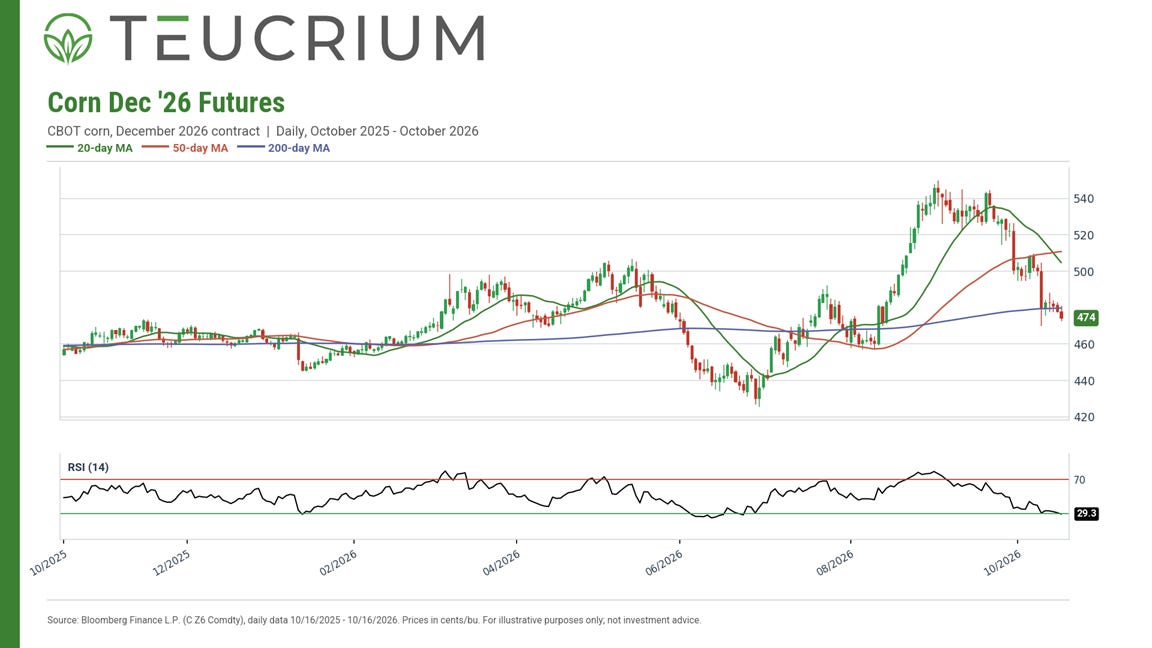
December corn settled at $4.74 1/4 on Friday, down 3 3/4 cents on the day and 5 1/2 cents on the week, the lowest close since mid-August and a second straight weekly low close. December is now 71 3/4 cents off its September 1 high of $5.46.
Traders spent the week questioning USDA’s corn supply estimates. Pro Farmer economist Lane Akre tallied the 411 million bushels USDA added across the September 30 stocks report and the October crop report, then noted that cash markets moved as if supply were tight: national basis improved after the report and the December-March spread narrowed from 14 3/4 cents of carry to 13 1/2 in under a week, which he reads as “a supply-constrained market, not a supply-abundant market.”
His sharpest point was about Nebraska. USDA estimates yield by measuring corn in a sample of fields. In September, 10% of the Nebraska fields USDA sampled were irrigated. In October, 55% were. Irrigated fields usually yield more than fields that rely on rain, and USDA’s Nebraska yield estimate rose 11 bushels an acre between the two reports. Akre’s point is that some of that increase may come from which fields USDA sampled, not from a bigger crop.
Pro Farmer is holding its Crop Tour yield at 173.2 against USDA’s 181.2; consultant Michael Cordonnier moved to 180.0 and expects trims in November or January.
Harvest was 33% done as of Sunday against a 39% average, the slowest since 2019, with Iowa at 14% versus 34%, and conditions ticked up 2 points to 56% good to excellent.
Corn prices fell this week, but demand for US corn held up, which gives prices a reason to bounce. Export sales rose to 44.2 million bushels for the week ended October 8, the most in 5 weeks and in line with the 5-year average, with Mexico the biggest buyer. Total sales for the season, 814 million bushels, are still 32.7% behind last year. This week, Japan bought 127,000 metric tons in a Friday flash sale and South Korea bought roughly 395,000 tons across 3 tenders. Castle expects more buyers who sat out the rally to “step forward to take advantage of the break in prices.”
China is unlikely to be one of those buyers. Cofco expects China to import 3.5 million tons of corn this season, less than USDA’s 5 million, because it sees China’s own crop 5 to 8 million tons larger. Beijing also left its 2027 import quota unchanged at 7.2 million tons. Vaclavik notes that Chinese buyers would lose money importing corn right now, even at the low 1% tariff on imports within the quota.
Ethanol plants are also buying corn. They produced an average of 1.065 million barrels a day in the week ending October 9, slightly less than a year earlier. Iowa State’s model showed the average Iowa plant still making money in September, the most recent reading available. On Tuesday, EPA proposed adding 770 million RINs back into refiners’ 2026 and 2027 requirements. RINs are the credits refiners use to show they blended biofuel. If EPA makes the rule final, refiners would have to blend more renewable fuel, much of it ethanol, and ethanol plants would need more corn. Public comments on the proposal are open until December 4.
Speculative funds were the main sellers. Managed money cut its net long 83,414 contracts to 246,425 as of Tuesday, the largest of 4 straight weeks of selling that have taken 168,035 contracts off the September 15 record of 414,460. Sernatinger’s Friday note called it “a capitulation day” with margin calls forcing traders to sell, and he wrote Thursday that he’s “still negative on prices here, but cautious after a 70 cent break off the highs.”
Watch for Monday’s Crop Progress after a dry weekend with combines back in the field, and for farmer reported yields. Pro Farmer expects either cash prices or USDA’s yield estimate to move until the two agree, but USDA doesn’t update its yield estimate until November 10.
Next Thursday’s export sales report will be the first to show whether foreign buyers stepped in after corn fell on USDA’s October crop report. Pro Farmer is watching two prices for December corn. The first is $4.70 1/2, the low it hit the day that report came out. A close below it would likely bring more fund selling. The second is $4.93, where Pro Farmer expects a rebound to stall. If December holds above $4.70 1/2 and export sales keep improving, prices could climb back toward $4.93. Cash prices already point that way: buyers of actual corn are paying more relative to futures, a sign that supply is tighter than USDA’s numbers suggest.
Wheat
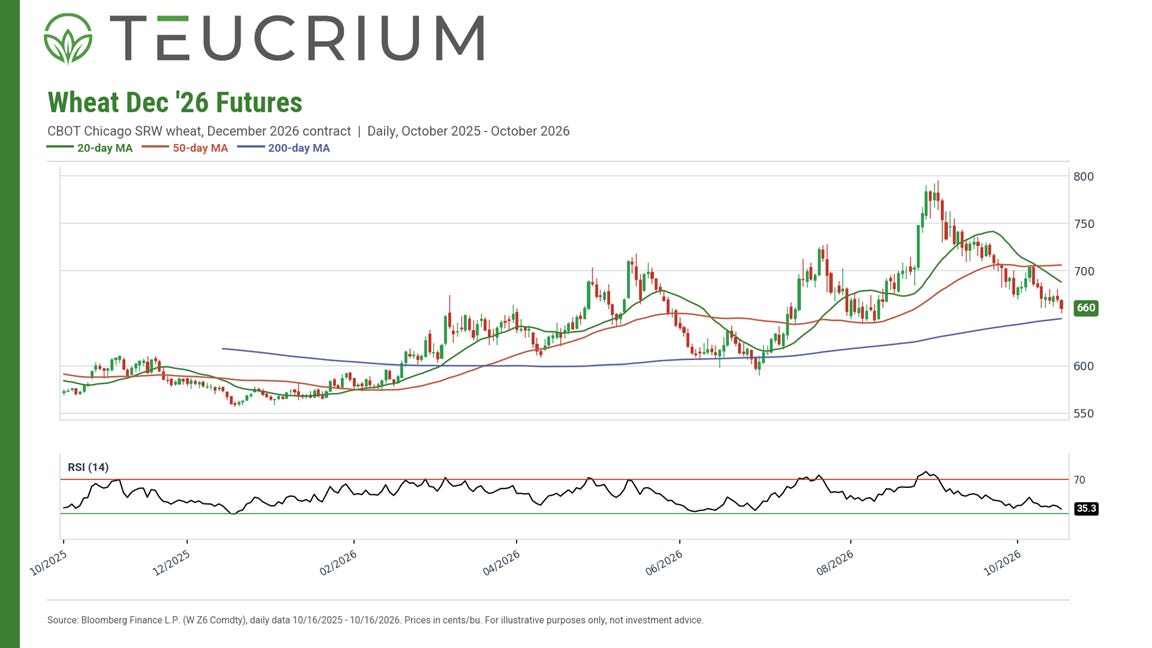
December Chicago wheat settled at $6.60 1/2 on Friday, down 10 1/4 cents on the day and 10 1/2 cents on the week, a 2-month low, and it led the grain complex lower to close the week. Sernatinger noted Friday morning that December Chicago had fallen through $6.61 1/2, a low the contract had bounced off twice before.
Russian attacks on Black Sea shipping increased for a third straight week, and wheat still fell for a third straight week. Russia sank a cargo vessel off Bulgaria Tuesday with 11 sailors missing, the second deadly sinking in NATO waters in a week, and struck vessels inside Romanian territorial waters Thursday.
Russia exported no wheat from the Black Sea last week and 419,000 metric tons from the Baltic; ProZerno puts July-September Russian wheat exports at 4.8 million tons against 10.6 million a year ago, and IKAR trimmed the crop to 88 million and exports to 42 million.
Ukraine’s farmers union capped 2026/27 wheat exports at 11 million tons, 1.5 million under USDA, with the Sulina Canal closed by weather on top of the drone attacks. None of the lost Russian and Ukrainian supply turned into US export sales.
Weekly sales of 11.8 million bushels left cumulative exports at 383 million, down 32.6% and the weakest pace in 3 years. Algeria bought 660,000 to 720,000 tons of milling wheat this week from other origins, Russian Baltic wheat is still offered at $268 a ton, Argentine December at $238, and Marex’s Friday midday read was blunt: “US wheat still not competitive.” The dollar hit an 18-month high Monday and Wednesday, which made US wheat more expensive for foreign buyers.
Winter wheat planting reached 51% against a 58% average, which Castle notes is still the slowest for the week on record, even with Kansas adding 20 points, and the drought monitor has 53% of winter wheat area in drought.
Crop size and quality problems kept growing in other exporting countries: Saskatchewan was 41% harvested by September 21 against an 82% average with sprouting reported, Rabobank cut Australia to 31 million tons (down 13%), Conab has Brazil at 5.73 million against 7.9 million last year, and frost hit central Argentina as rain delayed its harvest start.
Managed money extended the Chicago net short to 32,555 contracts as of Tuesday, a fifth straight week of selling from a 4,873 long on September 8, and cut Kansas City to 17,345 from 48,826 on September 1.
Watch for Monday’s planting number and whether the dry week ahead lets Kansas and Oklahoma close the gap; crop insurance prices at a 4-year high give farmers a reason to plant more, and a big catch-up in planted acres would mean more supply next year after this year’s small crop. Jordan tenders October 20 for 120,000 tons and Nigeria and Colombia are in the market; if US wheat wins any of these tenders, it would be the first sign that buyers are turning to US wheat because of crop quality problems in Canada and Argentina. Chicago’s relative strength index sits near 35, close to the 30 level traders read as oversold, and funds have sold for 5 weeks. Any disruption to Russia’s Baltic exports could send funds buying back their shorts and lift prices, but until US export sales improve, prices may keep drifting lower.
Sugar
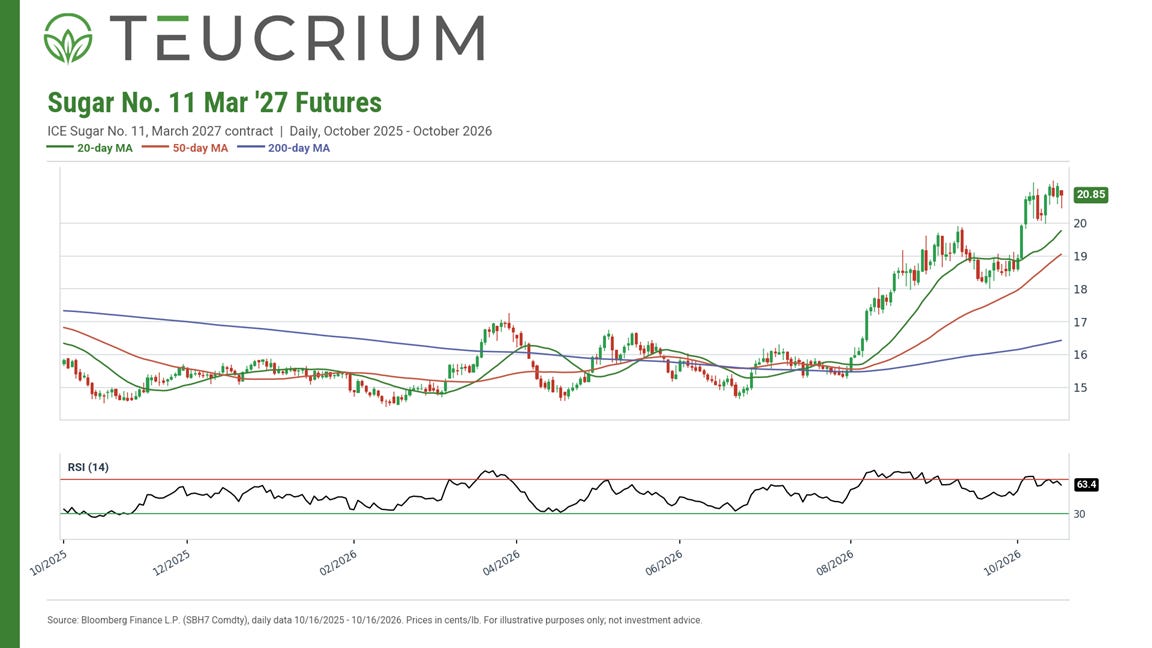
March raw sugar settled at 20.85 cents per pound on Friday, down 0.28 on the day and up 0.60 cents, or 3.0%, on the week.
Brazil’s agriculture ministry put Center-South sugar production for the second half of September at 2.86 million metric tons, down 6% from a year earlier, on crush of 38.64 million tons (down 2.9%) and ethanol output down 9.5%.
Czarnikow raised its 2026/27 global sugar deficit forecast to 500,000 tons from 300,000 after cutting its Center-South sugar production forecast by 500,000 tons to 38.1 million; roughly 7 harvest days were lost in the first half of October to heavy rain.
India’s crop news also pointed to less supply: Maharashtra’s sugar commissioner cut the state’s 2026/27 output to 9.02 million tons from the 10.25 million projected in September, against 9.9 million last season, with cane yields seen at 74 tons a hectare versus 95 a year ago.
In Karnataka, sugarcane farmers blocked highways for 3 days. They want mills to pay 5,500 rupees a ton for cane, and they want a minimum sugar price of 60 rupees. Separately, India’s central government told mills they can sell all the sugar they make in October during October and November, on top of their regular sales quota, so stores have enough sugar for the festival season.
Some traders are doubting the strength of the rally pointing to speculative trading rather than stronger demand for actual sugar. Asian traders told UKR Agroconsult that speculative funds drove the price gains, buying because they expect El Niño to hurt crops, while refiners and other buyers of actual sugar are buying little.
The premium buyers pay over futures for Thai sugar shipped March through May fell 5 points (0.05 cents a pound) this week, another sign that demand for actual sugar is weak. Czarnikow raised its deficit forecast for this season, but it cut its forecast for the following season, 2027/28, in half to 1.4 million tons, because EU farmers are planting more sugar beets.
CFTC data supports the view that fund buying drove the rally. Managed money’s net long rose 7,035 to 259,549 contracts as of Tuesday, a 52-week high and the largest since December 2022, roughly 9,000 contracts under the August 2021 record.
A weaker dollar usually supports sugar, but sugar fell Friday even as the dollar dropped to a 2-week low from Monday’s 18-month high. Brazil’s ethanol exports of 340.99 million liters in September were the most since October 2022. Strong ethanol exports give Brazilian mills a reason to turn more cane into ethanol instead of sugar.
Watch for Center-South production data for the first half of October. If dry weather lets mills catch up on cane still standing in the fields, prices would likely give back some of this month’s gain; two more wet weeks would probably keep prices high, and Czarnikow warns some cane may not get cut at all.
Three other events could move prices. First, Brazil holds its presidential runoff on October 25. The result will likely move the real, Brazil’s currency, and that changes how many reais Brazilian mills earn for each dollar of sugar they export.
Second, farmer protests in Karnataka and Maharashtra could delay the start of India’s cane crush. The first weeks of crushing will give traders an early read on how much sugar India will have left to export, and every global deficit forecast depends on that export number.
Third, funds hold their largest bet on higher sugar prices in a year, while buyers of actual sugar are buying little. If funds start selling, prices could fall quickly. Friday’s 0.28-cent drop may be an early sign of that selling, because sugar fell even though the dollar weakened, which usually pushes sugar higher.
Soybeans
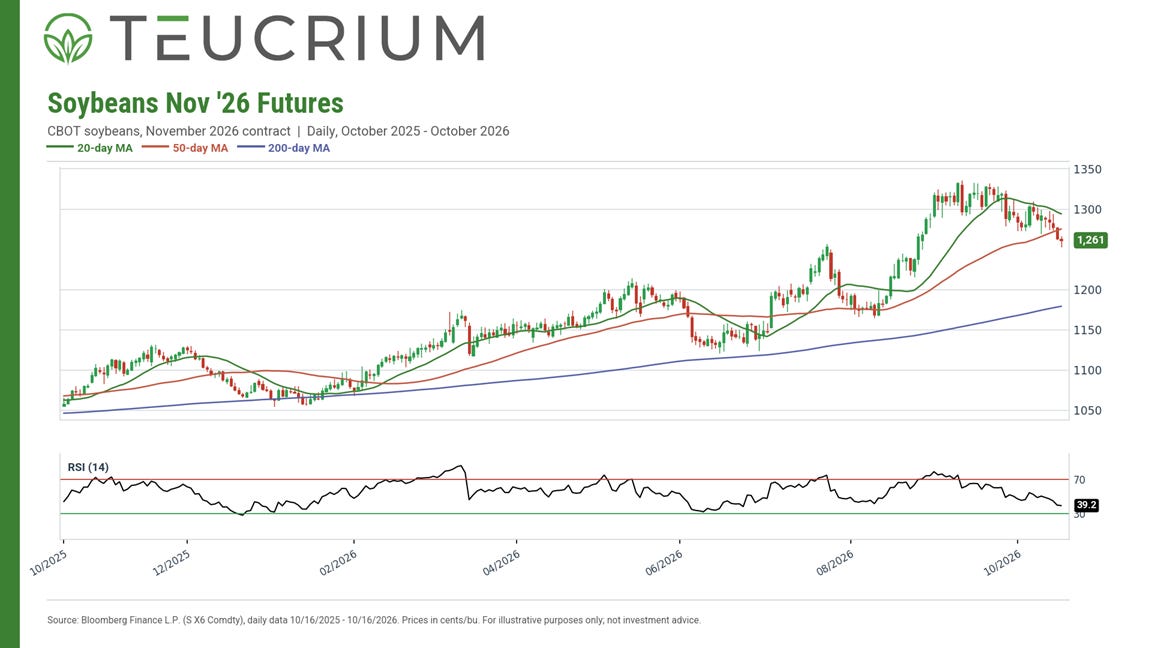
November soybeans settled at $12.61 1/4 on Friday, down 2 1/2 cents on the day and 30 3/4 cents on the week, the lowest close since late August. The contract lost ground all 5 sessions, and Thursday’s 14 1/4-cent drop to $12.63 came the day after USDA confirmed China was buying again.
Reuters reported Wednesday that state buyers took 8 to 10 Panamax cargoes for shipment from December, paying $3.10 to $3.20 a bushel over January futures, the first purchases since the September 24 Trump-Xi meeting.
USDA then announced 1.877 million metric tons of flash sales over 3 days: 470,000 tons to China Wednesday, 330,000 to China and 283,450 to unknown destinations Thursday, and 558,000 to China plus 236,000 to unknown Friday.
That’s 69 million bushels, 49.9 million of it confirmed China, and Bloomberg reported another 20 cargoes booked late in the week. November futures fell anyway.
The National Oilseed Processors Association reported Thursday that members crushed 196.3 million bushels in September, a 13-month low, 4.5% under August and 7 million under the trade guess, as plants took maintenance downtime and the slow harvest left some short of beans.
Soyoil stocks fell to 1.05 billion pounds, the lowest since November 2014. StoneX’s Mike Castle wrote that the weak September “takes some of the wind out of the proverbial sails,” meaning USDA’s record 2.78 billion bushel crush forecast for the season now looks harder to reach.
Weekly export sales for the week ended October 8 came in at 21.1 million bushels, near the low end of estimates, because the report’s cutoff came before this week’s flash sales. Supply news from Brazil also pushed prices lower.
Conab raised its estimate of Brazil’s crop to a record 181.62 million tons Thursday. The estimate assumes 1.4% more planted area, the smallest increase in 20 years, and is still 4.38 million tons under USDA’s 186 million. StoneX Brazil has planting 20.2% done, the fastest pace in 4 years, and Mato Grosso, the largest soybean state, is a third planted.
The US soybean harvest was 46% done against a 50% average, the slowest pace since 2019. Iowa jumped from 5% to 31% in one week, and dry weather forecast through next week should let farmers harvest faster.
China’s import and crush data were weaker than the purchase headlines suggest: September imports of 11.88 million tons were down 8% from a year ago, Cofco says crushers are running at 55% of capacity, and Marex’s Friday note has Chinese cash bean and meal prices at one-month lows.
Managed money was net long 249,807 contracts as of Tuesday, down 8,259 on the week and 15,352 under the September 22 record. Funds still hold a near-record long after 4 straight weeks of lower closes, and 295,000 November contracts are still open 2 weeks before delivery. Holders who don’t want to take delivery have to sell those contracts, which is why Marex’s Charlie Sernatinger wrote that “most signs are pointing to a liquidation trade for the rest of the month.”
Watch for next Thursday’s export sales report, the first to include this week’s China purchases; Marex expects a large total. Whether China keeps announcing purchases next week matters more than any single sale, because steady buying would show China is back as a regular customer. Standard Grain’s Joe Vaclavik notes that no one has said whether this week’s purchases count toward China’s 25 million ton annual purchase pledge or come in addition to it.
Sinograin auctions another 504,000 tons of reserve beans October 20. Brazil holds its presidential runoff October 25, with Flavio Bolsonaro polling 51 to 49 over Lula. If the result strengthens the real, Brazilian farmers get fewer reais for each dollar of soybeans they sell and tend to sell more slowly, which could support US prices. Marex’s midday weather forecasts turned drier for Mato Grosso 6 to 10 days out, the first forecast in weeks to match an El Niño weather pattern.
If the US harvest catches up and crush stays slow, prices may keep falling toward the August trading range. If China keeps buying after prices have already dropped 70 cents from the September high, that demand could stop the decline.
Topics:
