


Corn
Corn futures held a choppy, indecisive tone this week as prices pushed and pulled around key technical markers without the conviction to break meaningfully in either direction. Support emerged on any weakness toward the 20-day and 200-day moving averages, while resistance remained firm as December ’25 futures pressed into and slightly above the 50% Fibonacci retracement near $4.35.
With the government easing back into its routine after an extended hiatus, new data has been slow to surface, leaving traders cautious ahead of upcoming announcements. Export sales continue to play catch-up, though fresh business surfaced late in the week with reported purchases from both Mexico and Colombia. The U.S. retains a notable presence on the global demand landscape, but record production from the past season continues to weigh on cash markets.
South America remains a focal point as planting progresses and Brazil’s summer crop—the first of the year—reaches completion. Global supplies are abundant for nearby needs, and with expectations for large South American crops ahead, traders appear hesitant to chase strength toward or above $4.50 unless weather models begin signaling more problematic patterns.
Ongoing unrest in the Black Sea keeps certain trade routes constrained, directing more demand toward U.S. supplies and offering underlying support on dips. Still, upside momentum seems limited until clearer catalysts emerge.
Key Levels: Resistance scales toward $4.50 where farmer selling is expected to increase. Support strengthens between $4.30–$4.15.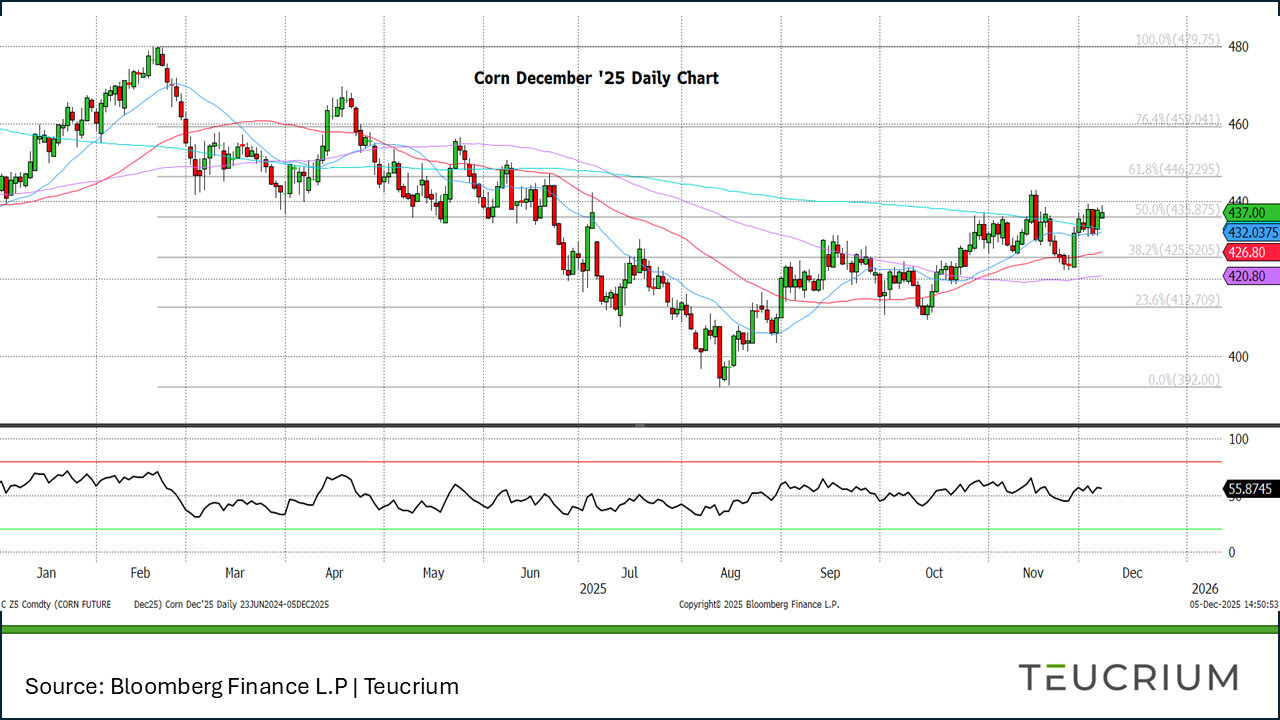
Soybeans
Soybean futures faded steadily through the week as limited fresh input restricted any meaningful follow-through for January ’26. The market continues to digest the sharp rally following the U.S.–China trade agreement, which injected bullish near-term sentiment but left traders questioning how long China’s U.S. buying window will remain open.
South American planting is off to a neutral start—some localized issues but nothing broadly concerning—keeping private estimates trimmed yet still supportive of a potentially large crop. The likelihood of sizable South American supplies early in 2026 weighs on nearby strength, especially after futures rallied more than $1.50 following the trade agreement.
U.S. supplies continue to move toward China, and reports suggest additional follow-up inquiries, but with harvest beginning in late January into early February in Brazil, time remains limited. China also remains active in sourcing lower-priced Brazilian beans, a reminder that U.S. upside momentum may struggle without new catalysts. As with corn, headlines will remain a driving force, but current price levels challenge the market’s ability to extend gains.
Key Levels: Resistance holds near $11.50. Support surfaces around the 76.4% Fibonacci retracement, with bears eyeing a move back toward or below $11.00.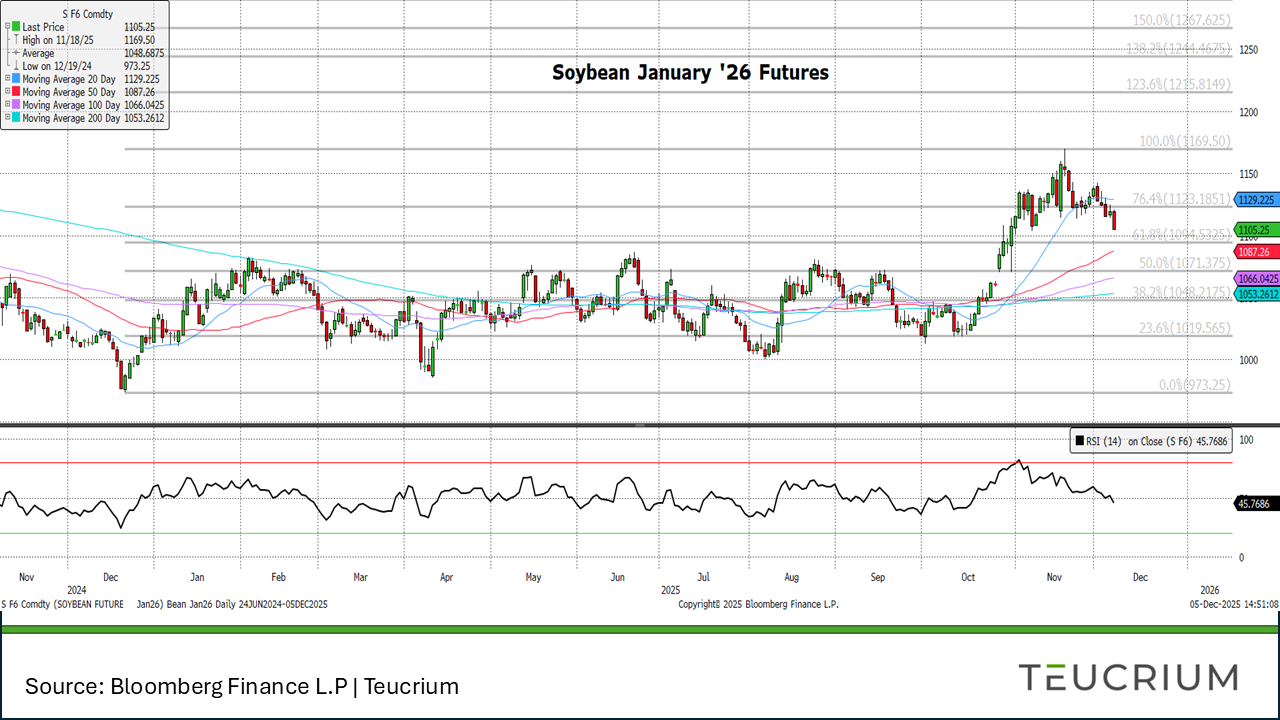
Wheat
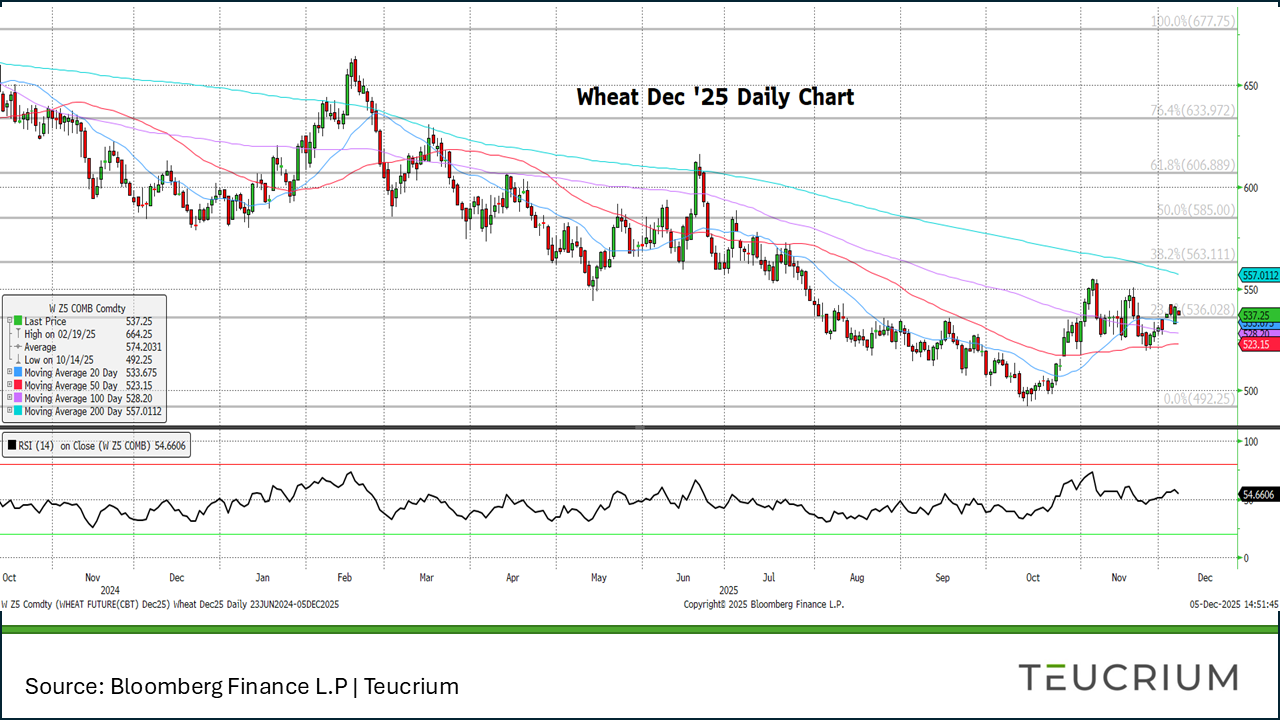
Wheat futures opened the week with modest strength as ongoing geopolitical tensions in the Black Sea captured trader attention. Russia continues to posture, but futures once again failed to generate the follow-through needed to test recent highs. December ’25 Chicago futures remain locked in a narrow band: resistance near $5.50 following last week’s U.S.–China agreement and support around $5.25.
This back-and-forth trade leaves technical indicators neutral, with RSI sitting near 55—a reflection of muted conviction as year-end approaches. Fundamentals continue to lean bearish with ample supplies in the U.S. and abroad, keeping a lid on prices as the market transitions into early 2026.
Chatter persists about reduced winter wheat plantings this season and declining acreage projections for next spring. If realized, these cuts may help stabilize prices under pressure. Traders remain focused on data updates—notably next week’s USDA crop report—which has encouraged early positioning and a cautious trading posture. Expectations for large numbers have many watching for another slide to test proven support.
Key Levels: Support extends toward $5.25–$5.10. Resistance remains anchored near $5.50.
Sugar
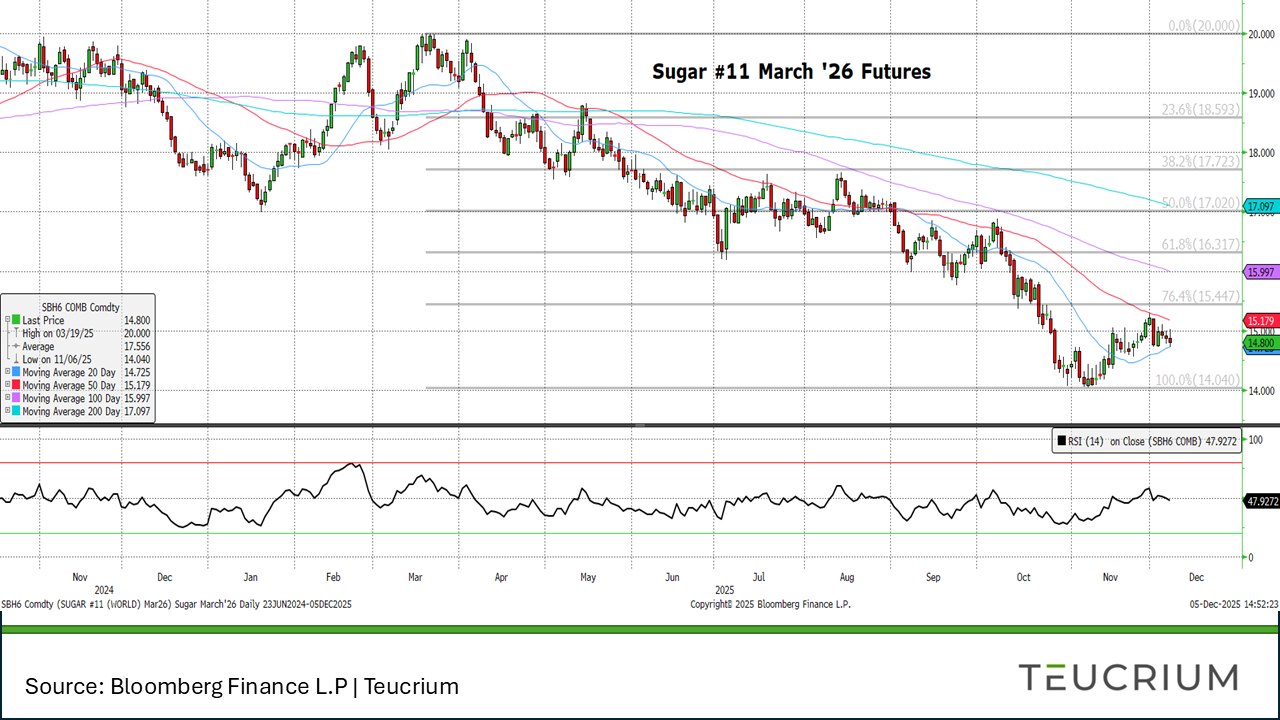
Sugar futures spent the week consolidating in a narrow band, trading between major moving averages while hovering near the $0.1500 pivot in the March ’26 contract. The market lacked clear direction, chopping back and forth with downside pressure emerging on any attempt at strength. The 50-day moving average sits just above the market near recent highs around $0.1517, while the 20-day offers nearby support at $0.1473. RSI rests right near 50, reinforcing the indecisive tone.
Fundamentally, mixed signals defined the week. Reports out of Brazil indicate increased cane allocation toward ethanol production, potentially tightening sugar availability. However, India countered with sharply higher year-over-year production estimates and requests for higher export allowances—an offsetting bearish influence.
Traders continue to monitor Brazil’s ethanol flows, broader energy market strength, and any shifts in global supply expectations. Bears maintain focus on a potential retest of support toward $0.1450, with the contract lows near $0.1400 remaining in play should weakness accelerate.
Key Levels: Support at $0.1450 with downside risk toward $0.1400. Resistance stands between $0.1525–$0.1550.
Topics:
